We analyzed 986 images shortlisted for the Astronomy Photographer of the Year competition in the past six years to find the best dedicated astronomy cameras for planetary and deep sky imaging.
Using this objective data we are able to recommend the cameras being used and then you can then be certain what they deliver for, rather than just looking at the key specifications.
Firstly, ZWO cameras dominate, and so that is what we recommend. You can see our quick picks here:
- We recommend the ZWO ASI174MM as the best lunar and solar camera, with the ZWO ASI678MC as the color planetary camera.
- The ZWO ASI2600MM Pro is then the best deep-sky model, with the ZWO ASI6200MM Pro as the premium pick for DSO.
Read on for further insight into the data, the pros and cons of these models, and all you need to know about CMOS cameras for astrophotography.
Best Lunar & Solar 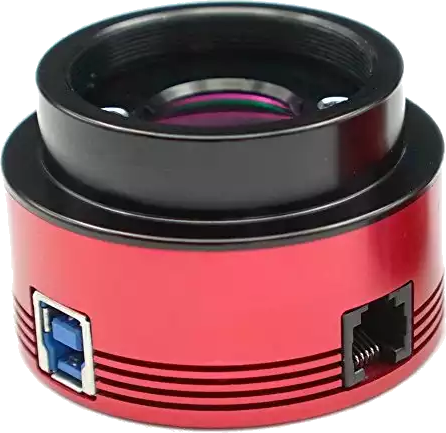 | Best Planetary 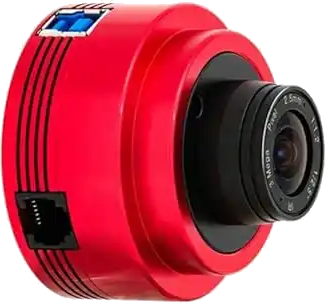 | Best Deep Sky 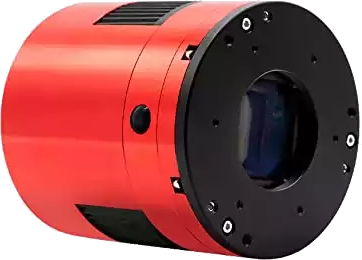 | Premium DSO 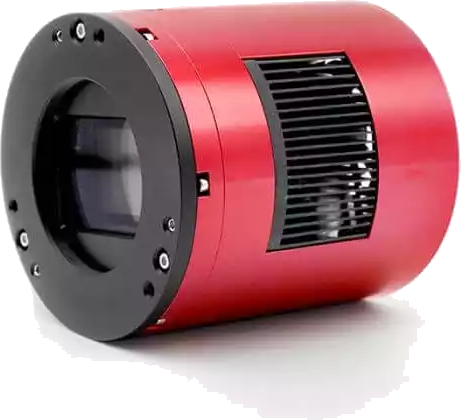 |
Make & Model: ZWO ASI174MM | Make & Model: ZWO ASI678MC | Make & Model: ZWO ASI2600MM Pro | Make & Model: ZWO ASI6200MM Pro |
Resolution: 2.3 MP | Resolution: 8.9 MP | Resolution: 26 MP | Resolution: 62 MP |
Color/Mono: Monochrome | Color/Mono: Color | Color/Mono: Monochrome | Color/Mono: Monochrome |
Cooled/Uncooled: Uncooled | Cooled/Uncooled: Uncooled | Cooled/Uncooled: Cooled | Cooled/Uncooled: Cooled |
ZWO ASI174MM
Best for Lunar & Solar Imaging
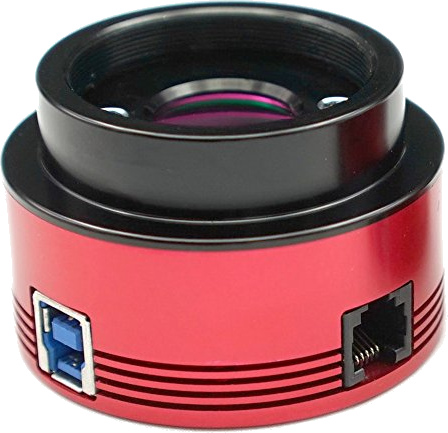
The ZWO ASI174MM is the most successful of any CCD or CMOS dedicated astronomy camera in the Astronomy Photographer of the Year competition.
17% of all shortlisted images using CMOS camera in the competition were taken with this camera which provides pretty conclusive evidence that it can deliver.
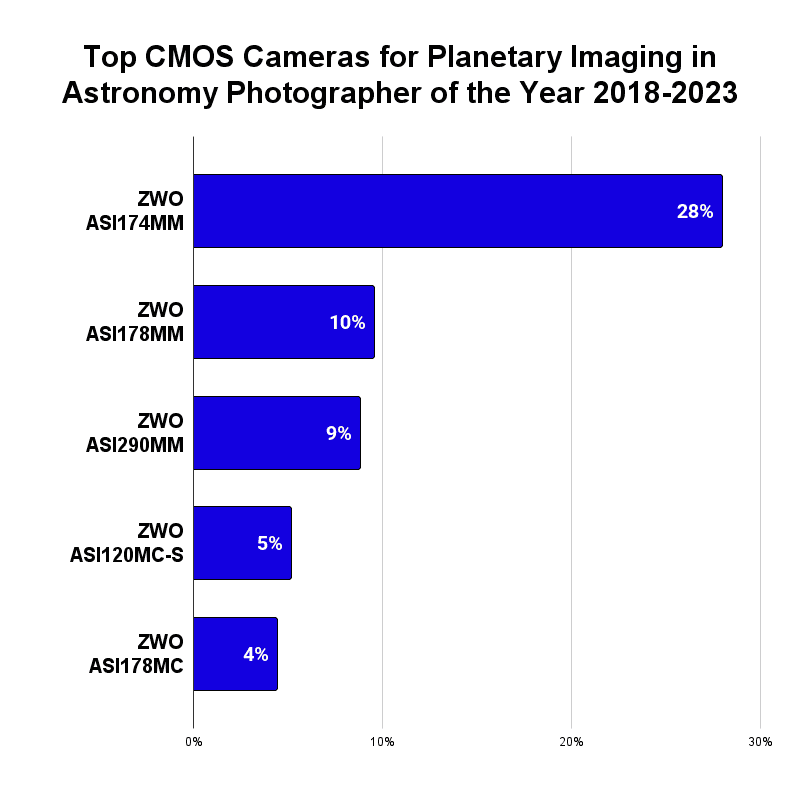
If we look at the data for just planetary images, we can see that it accounts for nearly a third of all planetary images taken with CMOS cameras and the majority of these are lunar and solar images:
It is an uncooled CMOS monochrome astronomy camera with the Sony IMX174 sensor and a resolution of 2.3MP (1936×1216).
It can take 164 frames-per-second (fps) at its full resolution of 1936×1216. This frame rate can be increased to up to 397 fps at a lower resolution.
As with any monochrome astronomy camera, to produce color images it needs to be used with a filter wheel and a set of LRGB color filters. You can buy these separately or you can get the camera as a package with a manual filter wheel or an electronic filter wheel.
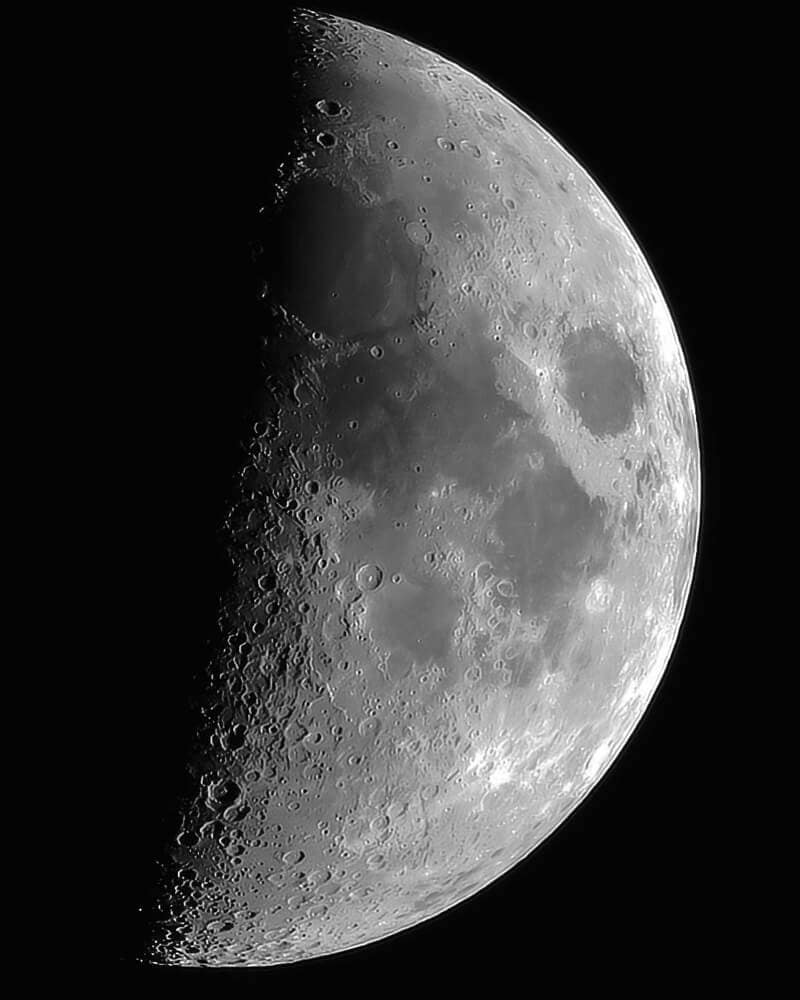
Whilst it excels for planetary, it can also be used for deep space astrophotography imaging, however, it will not perform as well as a cooled higher-resolution CMOS camera. There was previously an ASI174MM-Cool, but it has been discontinued.
This video gives a good high-level overview of the camera:
Overall, the ASI174MM provides excellent performance for planetary photography and is extremely good value for money. This makes it a great option for amateur imagers to incorporate into their astrophotography setup.
It is also one of the best cameras for lunar and solar (H-Alpha) imaging and can be used as a guide camera.
Key specifications
- Type: CMOS
- Sensor: Sony IMX174
- Specialization: Planetary, Lunar, Solar (with an additional solar filter)
- Resolution: 2.3MP
- Pixel Array: 1936 x 1216
- Pixel Size: 5.86 microns
- Full Resolution Frame Rate: 164 fps
- Color/Mono: Monochrome
- Cooled/Uncooled: Uncooled
- Quantum Efficiency (QE): 77%
- Read Noise: 6E
- Full Well: 32ke
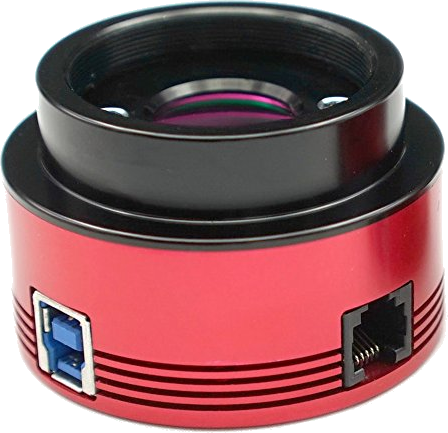
2.3 MP CMOS Monochrome Astronomy Camera
- Capture high-resolution monochrome images of the Moon, Sun, planets, and some deep-sky objects
- Advanced CMOS sensor with 1936 x 1216 (2.35MP) resolution
- Fast USB 3.0 transfer at up to 164 frames per second at maximum resolution, with higher data transfer rates at lower resolution
ZWO ASI174MM vs Mini
The ASI174MM comes in two different versions – the standard version featured above and the ASI174MM-Mini.
The main difference is that the standard version uses USB 3.0, whereas the Mini version has a slower USB 2.0 port. This means that the standard model is a better imaging camera as it can transfer data much quicker.
The Mini version is therefore primarily a guide camera, although can be used for planetary imaging.
ZWO ASI2600MM Pro
Best value DSO Camera
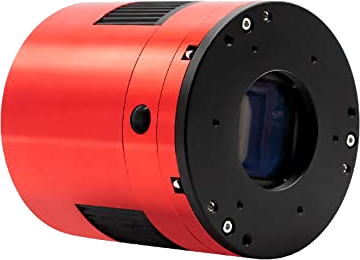
The ZWO ASI2600MM Pro is our recommendation for the best dedicated astronomy camera for deep-sky objects (DSO).
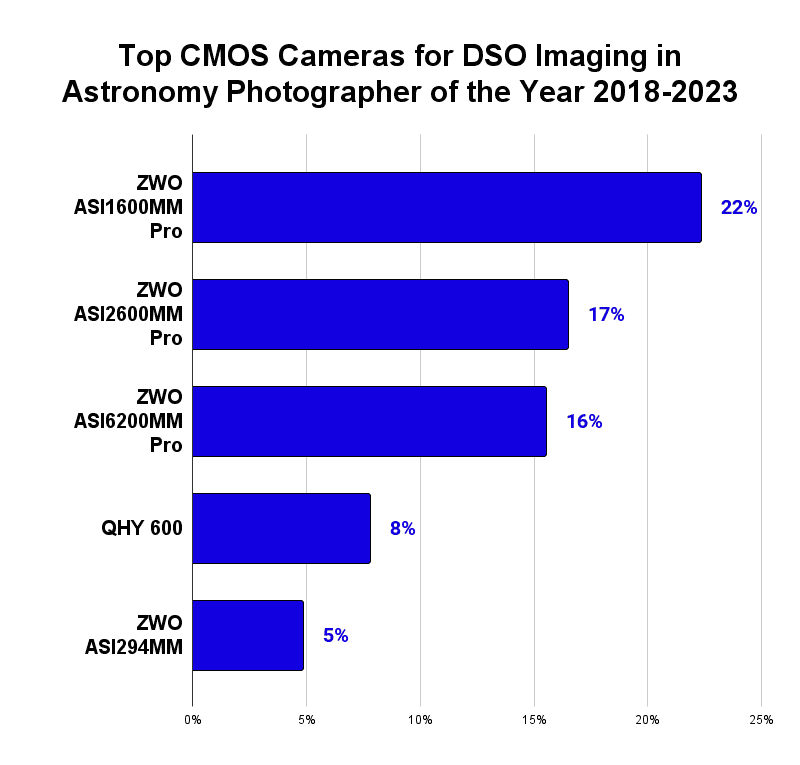
It is the upgrade model from the now-discontinued ZWO ASI160MM Pro which, as you can see in the chart below, was the most successful dedicated astronomy camera for deep space images, followed by the ASI2600MM Pro.
Together these two models account for 39% of all deep-sky images taken with CMOS cameras in the competition:
It is a cooled CMOS camera with 26 MP resolution.
The high resolution is great for photographing galaxies and nebulae, and the cooling makes it much better for deep-sky object imaging as it reduces noise.
Its full-resolution frame rate is 3.5 fps, which can increase to 51.4 fps at a smaller resolution.
As a monochrome camera, it needs to be used with a filter wheel and LRGB color filters to create color images.
This video from Wido talks through him upgrading from the ASI1600MM to the ASI2600MM:
Overall, this is a great value deep-sky object camera that can clearly deliver as you can see from its performance in our research.
Key specifications
- Type: CMOS
- Sensor: SONY IMX571
- Specialization: Deep Sky Objects
- Resolution: 26 MP
- Pixel Array: 6248 x 4176
- Pixel Size: 3.76 microns
- Full Resolution Frame Rate: 3.5 fps
- Color/Mono: Monochrome
- Cooled/Uncooled: Cooled
- Quantum Efficiency (QE): 91%
- Read Noise: 1.0-3.3e
- Full Well: 50000e
26 Megapixel Cooled Monochrome Astronomy Camera
- High 6248 x 4176 (26 MP) resolution
- Cooled for long exposures of deep sky objects
- Ultra-low 1.0e readout noise
ZWO ASI678MC
Best Color Planetary Camera
Color astronomy cameras are simpler and cheaper to use than monochrome cameras because:
- They can capture a full-color image in one shot, whereas monochrome cameras require multiple shots using different filters.
- This filtering requires additional components that increase the cost.
The downside of color CMOS cameras is that they will capture less data than monochrome ones and so have more limited imaging capacity.
For beginners a color CMOS model makes a lot of sense as your first dedicated astronomy camera to use with your telescope, since it is so much easier to get to grips with. You then have the option of upgrading to a monochrome camera with filters later as your imaging skills progress.
This is an uncooled camera with 8.9MP resolution that works best for planetary imaging as utilizes USB 3.0 and is good for fast frame rate imaging.
ZWO Color Dedicated Astronomy Camera for Planetary Imaging
- Advanced IMX678 CMOS sensor with 3840x2160 (8.29 megapixel) resolution
- Fast USB3.0 transfer at up to 47.5 frames per second at maximum resolution
ZWO ASI6200MM Pro
Best Premium CMOS Camera for DSO Astrophotography
The ZWO ASI6200MM Pro is the second most successful camera for deep sky imaging in the competition data (if you discount the ASI1600MM Pro as it has been discontinued and replaced).
It is a professional-level CMOS dedicated astronomy camera and comes at a premium price.
For the price though you get a huge 62 megapixel sensor alongside other stellar specifications to give you premium performance in your imaging.
The heart of this camera is the Sony IMX455 full-frame format sensor. This means you’re getting a massive field of view, allowing you to capture sprawling nebulas and galaxies in their entirety. The 62MP sensor, combined with a pixel size of 3.76um, ensures that you’re capturing every intricate detail the universe has to offer.
It boasts a true 16-bit ADC, providing a dynamic range of up to 14 stops. This translates to images with sharp contrasts, smoother gradients, and a richness that’s hard to find in other cameras.
With an ultra-low readout noise of 1.2 e- and zero amp-glow, your images will be pristine, even during long exposures. No more pesky post-processing to remove unwanted artifacts!
Despite its powerhouse performance, the camera weighs a mere 700 grams. This makes it incredibly portable and easy to mount on any telescope setup. The craftsmanship is evident in its build, ensuring durability and longevity.
It also features a backlit sensor. By moving components to the back-side of the silicon substrate, more light enters each pixel. This results in enhanced sensitivity and reduced noise, making your images pop with clarity.
The two-stage TEC cooling can lower the sensor temperature by over 35°C below ambient. This drastically reduces noise, ensuring that your long-exposure shots are as clear as possible.
Data transmission is smooth and efficient, thanks to the USB 3.0 interface and a built-in 256MB DDR3 cache. This means no dropped frames and reduced glow effects, even during extended exposures.
Lastly, it features a built-in polyimide heater, so that dew won’t stand a chance. Your lens remains clear, ensuring uninterrupted imaging sessions.
Overall, this is the best CMOS camera for deep sky astrophotography, but will only be in the reach of those with big budgets.
Key specifications
- Type: CMOS
- Sensor: Sony IMX455
- Specialization: Deep Sky
- Resolution: 62 MP
- Pixel Array: 9576 x 63888
- Pixel Size: 3.76 microns
- Full Resolution Frame Rate: 2 fps
- Color/Mono: Mono
- Cooled/Uncooled: Cooled
- Quantum Efficiency (QE): 91%
- Read Noise: 1.2e
- Full Well: 51400ke
Full Frame CMOS Monochrome Cooled Astronomy Camera
- One of the best dedicated astronomy cameras on the market
- 62-megapixel high-resolution monochrome full frame sensor
- 91% quantum efficiency with 16-bit ADC
- Ultra-low 1.5e read noise and 51,400e full well capacity
Best Dedicated Astronomy Cameras: Data
So, how did we get the information on which we have made these recommendations?
The Astronomy Photographer of the Year contest is the leading astrophotography competition in the world. Each year 100+ images are shortlisted with a smaller selection being named as winners in different categories.
The information about the equipment used in each photo is shared and so we brought this information together to see what the most successfully used gear has been.
You can see the full research in our article Astronomy Photographer of the Year: Winning Gear Analysis which also includes telescopes and mounts, but here, we focus on dedicated astronomy cameras.
Overall, there have been 986 images shortlisted in the competition in the past seven years.
When we take out landscape astrophotography images taken with DSLR/mirrorless cameras, we can examine just the images taken with dedicated astronomy cameras.
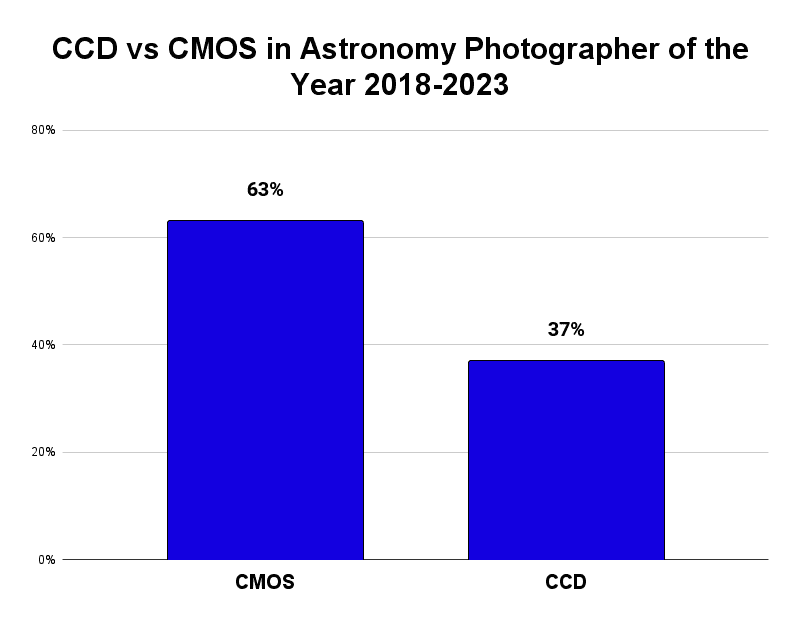
This is then split roughly two-thirds CMOS cameras, and one-third CCD cameras:
CMOS Astronomy Camera Manufacturers
If we look at the most successful manufacturers of CMOS cameras in the competition, we see that ZWO are by far the most successful, followed by QHY and Player One Astronomy:
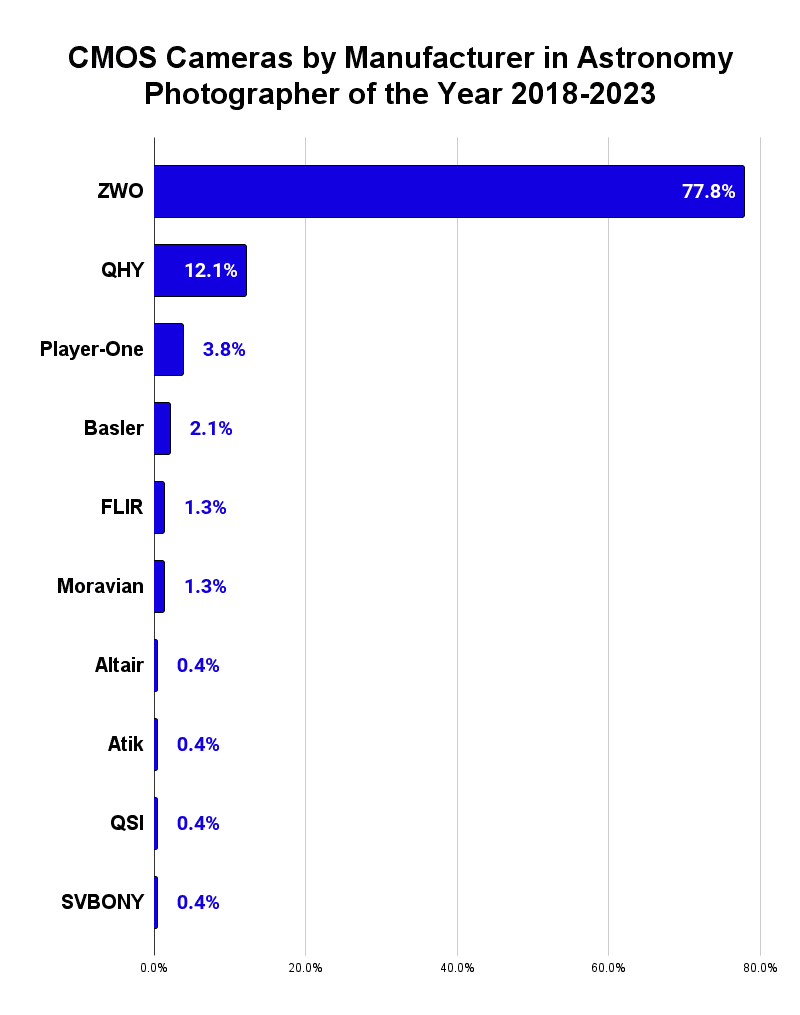
These results reflect the availability and affordability of cameras as well as performance.
Best CMOS Camera Models
Now we can look at the most used CMOS camera models in the competition:
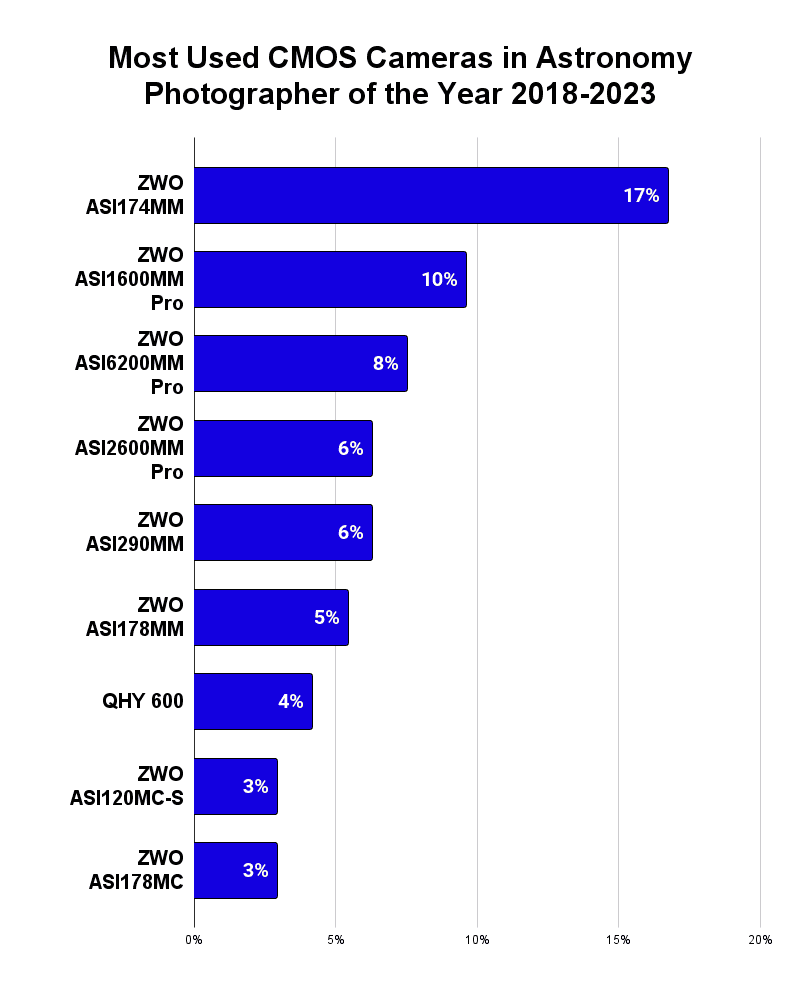
This data incorporates all planetary, lunar, solar, and deep sky images and so we need to dig a bit into this as the traits of a good planetary CMOS camera are not the same as a deep-sky CMOS camera. In short:
- Planetary CMOS cameras need a fast frame rate to suit how planets are imaged. They tend to have lower resolution and a USB 3 capacity to aid fast data transfer. Cooling is not necesssary
- Deep Sky CMOS cameras tend to have high resolution and a slow frame rate to match the longer exposure methods used. They require cooling to reduce noise in the images.
You can see that the nine ZWO cameras are in the top ten, alongside the QHY 600, which is a premium/professional-level CMOS camera.
The most popular model is the ZWO ASI174MM. As discussed above, this a versatile planetary camera that particularly excels for solar and lunar imaging.
The second highest is the ZWO ASI1600MM Pro. This is a deep sky camera that was discontinued and superseded by the ZWO ASI2600MM Pro, which sits fourth overall.
Above this in third is the ZWO ASI6200MM Pro (pretty easy to get these two muddled up with the name similarity!). Again, this is a DSO camera, but a higher-specification model that costs more.
The color cameras on this list are the ZWO ASI120MC-S and ZWO ASI178MC, which are both discontinued, which is why we recommend the ZWO ASI678MC. This is a great budget pick that is perfect for beginners to have a go at planetary imaging.
This is why these four cameras make up our recommendations in this article.
FAQs: CMOS Astronomy Cameras
CCD vs CMOS for Astrophotography: What’s the difference?
For the most part, it doesn’t really matter whether your camera has a CMOS or CCD sensor for astrophotography.
CCDs used to be significantly better for astrophotography but CMOS sensors have caught up in recent years as camera manufacturers have focused on making them better.
From our astrophotography competition analysis, we can see that CCD cameras are more successful for deep sky imaging:
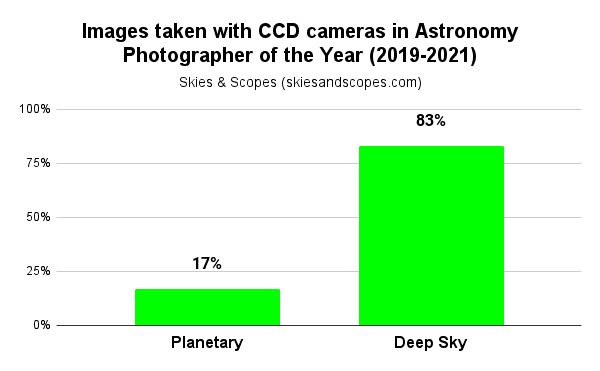
Whilst CMOS cameras were used more often for planetary imaging:
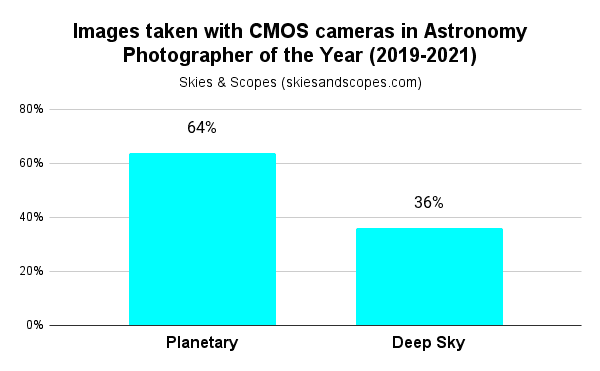
For the most part, amateur astrophotographers will generally use CMOS cameras. CCD cameras these days are more for observatories or for institutions like universities making scientific measurements and having bigger budgets.
Color vs Monochrome CMOS Cameras: Pros and Cons
CCD or CMOS cameras can be color or monochrome, each has its pros and cons:
- The advantage of color cameras is that you can get a full color image in a single exposure. However, the in-built color filtering limits the capacity of the camera’s sensor. This results in less data captured.
- The advantage of monochrome cameras is that they use the full capacity of the sensor to capture light as there is no in-built color filtering. The downside is that to get color images you need to use additional color filters with filter wheels controlled via computer to take multiple shots to then combine them in post-processing. This is more work and costs more to buy the additional components.
Overall, using a monochrome camera is more time-consuming, difficult, and expensive, but has much higher potential for producing great images. These are right for advanced imagers who want to put in the effort in capturing and processing images.
Color cameras are much quicker and simpler, but the images produced will be limited. This can be perfect for beginners though who are looking to do their first imaging with a dedicated astronomy camera.
You can see from our astrophotography competition analysis that the top cameras used are monochrome (indicated by “MM” in ZWO cameras). But there are color cameras in the list (see the ZWO models with an “MC” in the name).
Cooled vs Uncooled CMOS Cameras: Pros and Cons
The advantage of cooled cameras is that they reduce noise in images. This is especially important for long exposure deep sky imaging.
The downside is that they cost more and need their own power source and so need to be plugged in somewhere.
Uncooled cameras are cheaper and are perfect for planetary imaging, but less optimized for DSO imaging.
CCD/CMOS Camera Specifications: What Do They Mean?
Aside from CCD vs CMOS, cooled vs uncooled, and color vs monochrome, there are a number of specifications that give you insight into any camera model. These include:
- Resolution: The size of the images produced by the camera in megapixels (MP).
- Pixel Array: Another way of expressing the resolution with a width and height pixel measurement.
- Sensor size: Categories of sensor types, with the most common being micro four-thirds, APS-C, and full frame. Full frame is the biggest and best for deep sky imaging as it means more pixels and a wider field of view. Smaller sensors can be better for planetary photography as you want a narrower field of view, plus a larger image size slows your capture speed (and also fills up your computer’s hard drive).
- Pixel Size: The physical size of the pixels on the sensor measured in microns (µ). Higher is better for deep sky astrophotography as it indicates more light will be gathered per pixel, however, this also means lower resolution. For planetary imaging, smaller pixel size is usually better.
- Frame Rate: How many frames per second (fps) a camera can capture, also sometimes called capture speed. For deep-sky imaging, this is less important as exposures are usually fewer but longer. But planetary photography requires many shorter exposures and the higher the fps the better.
- Quantum Efficiency (QE): A measure of how efficient a sensor is at capturing light and converting it into an image. The higher the QE figure the better it is – especially for deep sky astrophotography. It is less important for planetary imaging.
- Read Noise: The lower this is the better. It is a measurement (in electrons per pixel) of the noise generated by the camera when imaging.
- Full Well Depth: How much light each pixel can absorb (measured in electrons). The higher the full well capacity the better as it means that you can expose for longer before losing detail.
- Bit Depth: The range of luminance values that each pixel can record – the higher this is, the better.
- Sensor Illumination: Sensors can be front-side or back-side illuminated. Back-side illuminated (BSI) sensors are generally better as they have a higher quantum efficiency.
- Sensor Diagonal: The distance from the opposite corners of a sensor. This tells you what image circle you need your telescope to support and the filter size you should use.
- USB: USB 3.0 is better than USB 2.0 as it means that imaging data can be transferred faster between camera and computer, especially if doing fast frame rate planetary imaging.
This video presents a good overview of the most important specifications to look out for and what they mean:
DSLR vs CCD/CMOS Astrophotography Cameras: Pros and Cons
The main advantage of using a DSLR (or mirrorless) camera for astrophotography is versatility. You may already own one and it can deliver for deep sky, planetary, and landscape astrophotography, as well as for all your daytime photography.
However, dedicated CCD and CMOS astronomy cameras are specifically designed for the task of low-light imaging and will outperform DSLRs and mirrorless cameras for planetary and deep-sky imaging with a telescope.
Dedicated astronomy cameras are also smaller and lighter, but do not have a screen to preview your images like DSLRs, or a built-in battery, so they need their own power source.
If you want a DSLR or mirrorless model for landscape astrophotography, see our article on the Best Cameras for Astrophotography.
What’s The Best Telescope To Use With CCD/CMOS Cameras?
CCD and CMOS astronomical cameras need to be used with the right telescopes and mounts to get results.
See the Best Telescopes for Astrophotography, the Best Telescopes For Planetary Imaging, and the Best Mounts for Astrophotography for more information and recommendations.
Verdict: Best CMOS Camera for Astrophotography
It can be extremely hard trying to work out what dedicated astronomy camera is right for you given the obscure model names and complex specifications.
That’s why we believe our analysis cuts through this and shows you the models that are being used most successfully at the highest level.
Overall, we recommend these cameras:
- ZWO ASI174MM for lunar and solar imaging
- ZWO ASI678MC for planetary imaging
- ZWO ASI2600MM Pro for deep space photography
- ZWO ASI6200MM Pro for premium DSO imaging
We hope you found this analysis useful. We also have separate articles on the Best ZWO Planetary and DSO Cameras and the Best Planetary, Lunar & Solar Cameras.
Please let us know your comments, questions, and recommendations in the comments below.