We analyzed over 1000 images shortlisted for the Astronomy Photographer of the Year competition in the past 8 years to find the Best Telescope Mounts for Astrophotography.
Our number one recommendation is the Sky-Watcher EQ6-R Pro. This is by far the most successfully used astrophotography mount.
There are other great alternatives though, whether you want a cheaper option or going up to a higher payload capacity.
See the quick summary below or read on to see the data:
— Best Overall: Sky-Watcher EQ6-R Pro
— Alternative Pick: Sky-Watcher HEQ5
— Best Budget: Celestron AVX
— Upgrade Pick: Celestron CGX
Astrophotography Mounts: Data and Research
For this article, we analyzed all images shortlisted for the prestigious Astronomy Photographer of the Year competition for the past five years (2018-2022) to see what telescope mounts were used.
Top Brands and Manufacturers
From the 685 shortlisted images that we looked at, we found that Sky-Watcher mounts are the most successfully used by some distance:
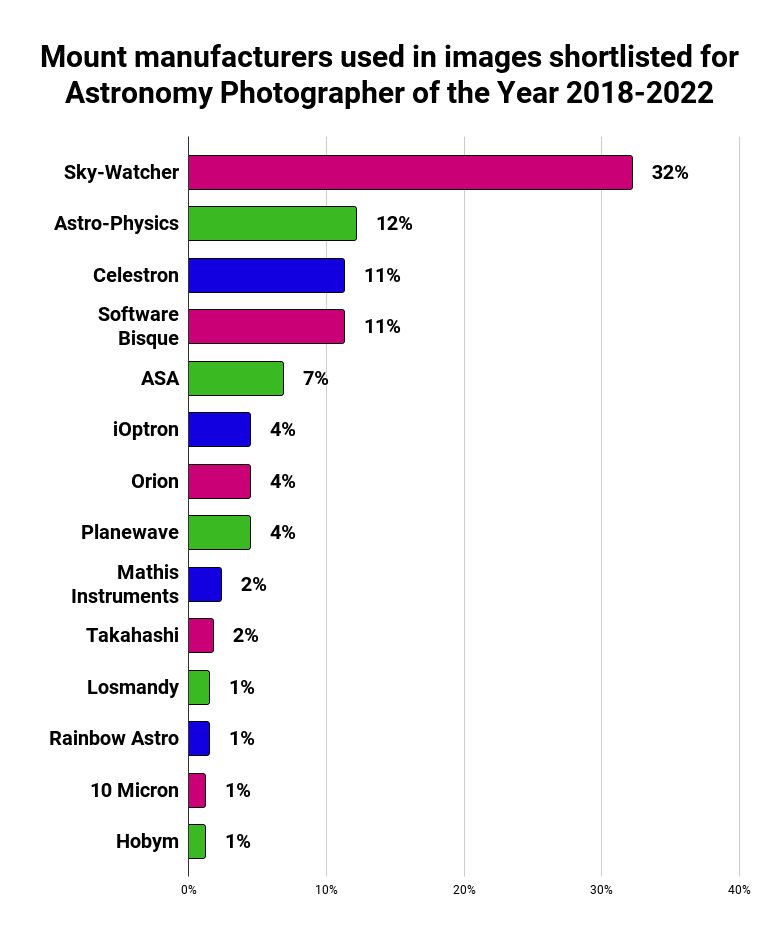
From the top five, Sky-Watcher and Celestron make a range of mounts from entry-level to advanced, whereas Astro-Physics, Software Bisque, and Astro Systeme Austria (ASA) make premium mounts for professional imagers and observatories.
Top Models 2018-2022
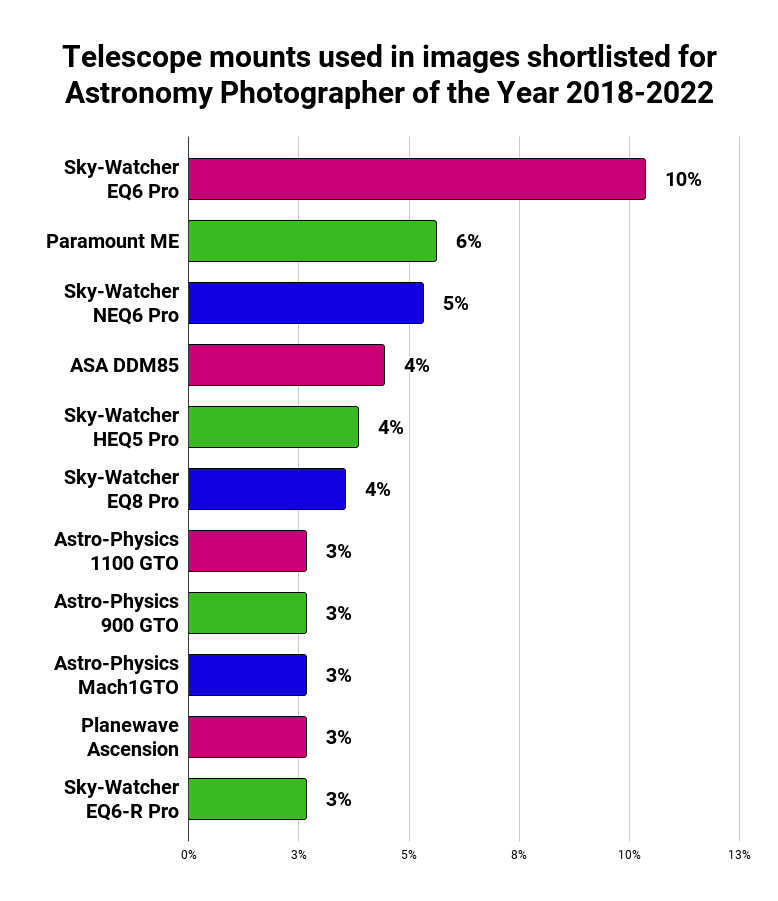
When we look at the individual mount models we find that the Sky-Watcher EQ6 Pro was the most successfully used overall. This is an older version of what has been superseded by the Sky-Watcher EQ6-R Pro, which is why this is our recommendation.
The similarly discontinued Sky-Watcher NEQ 6 Pro is third overall with the Sky-Watcher HEQ5 in fifth, and the Software Bisque Paramount ME comes in second overall.
The ASA DDM85 is fourth overall. This is a premium mount that has also been discontinued now. The closest available alternative is currently the ASA DDM100.
See the top results here:
Top Models 2021-2022
Given the number of discontinued models, it’s worth looking at the more recent data.
If we narrow it down to just the last two years, we see that the Sky-Watcher EQ8-R Pro has the top spot. This is a newer model from Sky-Watcher with a payload capacity of 110 lbs.
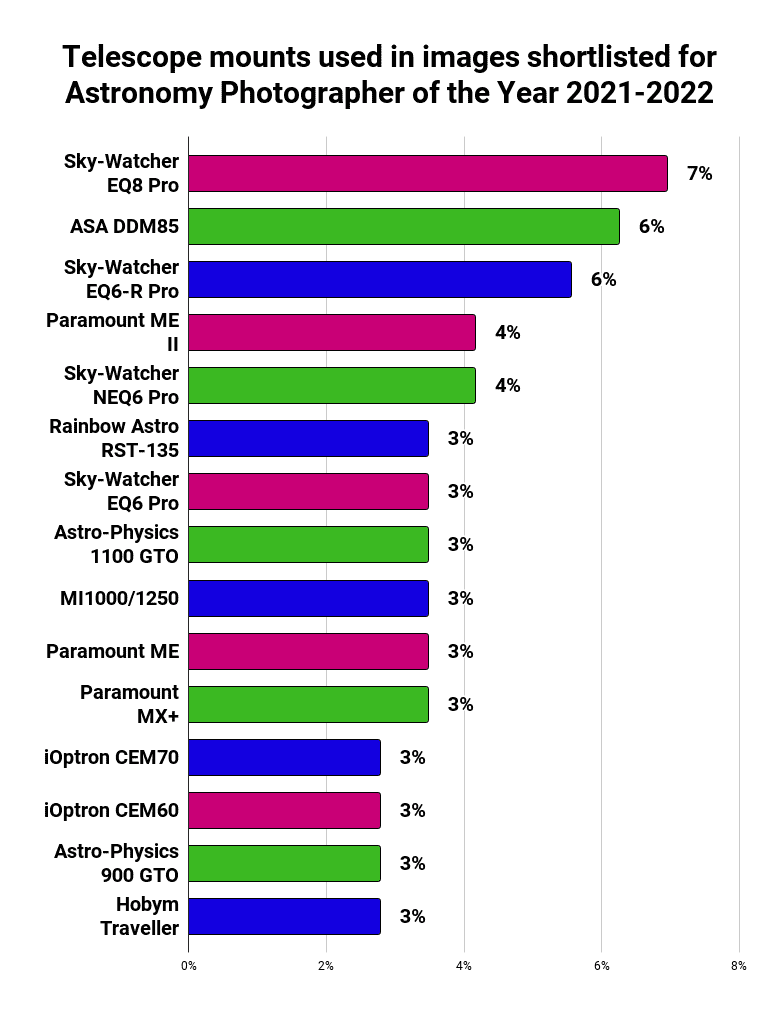
The Sky-Watcher EQ6-R Pro is again right up there along with the Software Bisque Paramount ME II.
Notably, newer models like the harmonic drive iOptron CEM70 – with a 70 lbs payload capacity – have become more popularly used in recent years.
Deep Sky Astrophotography Mounts
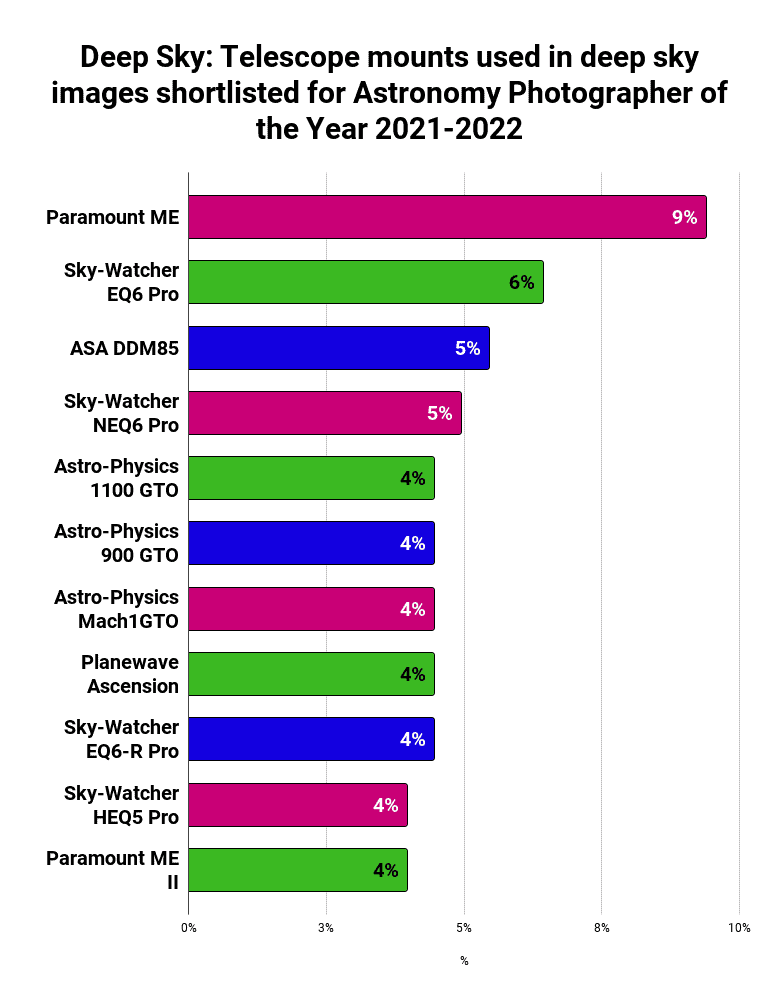
We can also break it down between what mounts are used for deep sky versus planetary imaging since they often have different requirements.
For deep sky, the Software Bisque Paramount ME is out front. This has a 240lb payload capacity and is for use as part of advanced professional setups.
The Astro-Physics 1100 GTO is also in the top five, and this is another premium mount with a 110lb capacity.
Mid-sized Sky-Watcher mounts in the reach of everyday astrophotographers like the Sky-Watcher EQ6-R Pro are also right up there:
Planetary Astrophotography Mounts
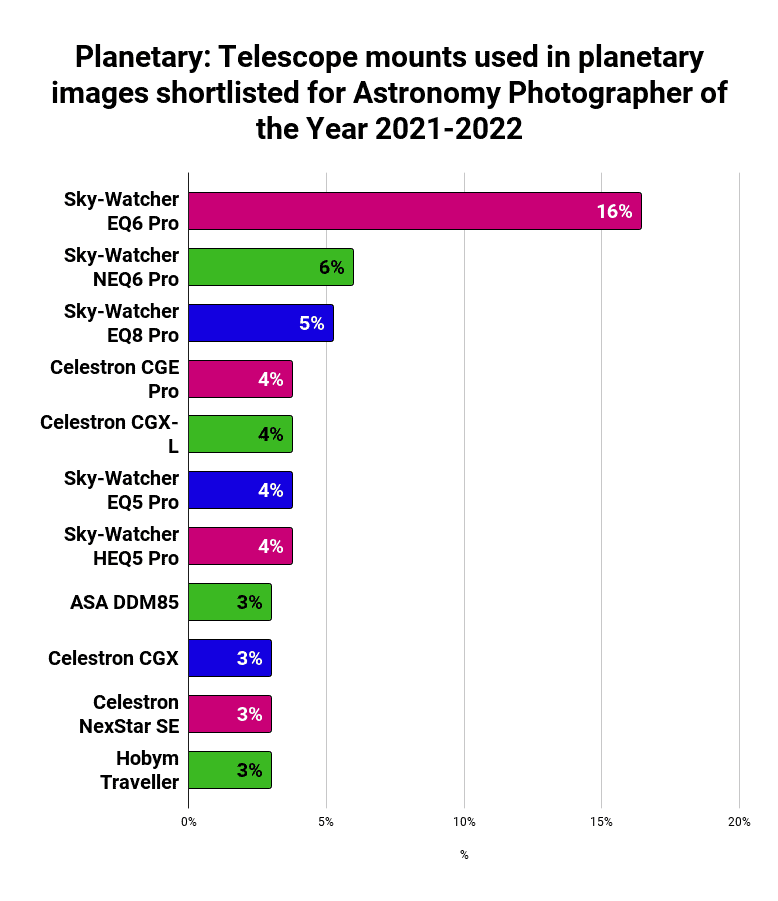
For planetary imaging, larger mounts like the Sky-Watcher EQ8-R Pro and Celestron CGX-L are more likely to be used.
This is likely for a higher payload capacity to deal with larger telescopes like the Schmidt-Cassegrains which excel for planetary imaging, although the mid-range Sky-Watcher models are at the top again:
We will now examine the top astrophotography mounts that we recommend and explore the pros and cons of each.
Best Telescope Mounts for Astrophotography
Sky-Watcher EQ6-R Pro
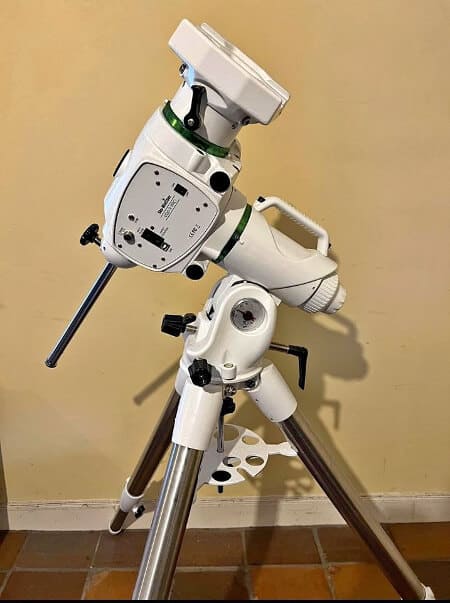
Our results show that the Sky-Watcher EQ6-R Pro was the most successfully used telescope mount in the Astronomy Photographer of the Year competition in the last five years. It is also the most commonly used mount in Astrobin’s equipment database.
It has all the key attributes you want in an astrophotography mount:
- Equatorial for smooth tracking of your target
- GOTO/computerized with a database of 40,000+ astronomical objects operated by hand controller
- High payload capacity of 44lbs
It will be the perfect choice for many given its proven performance, its versatility for both planetary and deep sky astrophotography, and its mid-range price which is below many premium mount options.
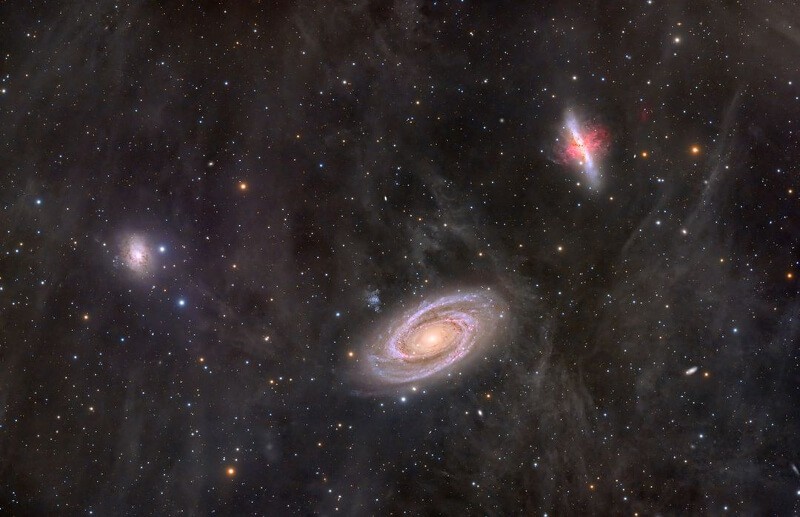
- It is a motorized GOTO equatorial mount which, as outlined below, is the best option for astrophotography.
- It has GoTo functionality using the included hand controller. With this you can get your telescope to automatically point to any of 42,000 objects in the night sky with the press of a few buttons. It also has a USB port so you can control it directly with a laptop or computer, enabling it to operate with alternative astronomy software.
- Its payload capacity is 44 pounds (20 kilograms), which should support most telescope and camera setups. The steel tripod comes included.
- Pretty much any telescope can be easily connected to it with Dual, Vixen and Losmandy Style mounting saddle plates.
- Tracking accuracy is 1 arcsecond and has periodic error correction (PEC).
- The stepper motor belt drive is quieter than the servo motor alternative and results in virtually silent slewing. This is pretty handy if you are sneaking into your backyard at night for imaging and don’t want to wake the neighbors.
- There is a port for an autoguider to be attached. This is a functionality that can further increase tracking accuracy for longer imaging periods.
- It includes an illuminated polar finderscope to help with polar alignment.
- A complaint that is sometimes raised about the EQ6-R Pro is that polar alignment is fiddly as you have to push in an awkwardly positioned lever which makes it difficult.
- You can input the date, time and location manually but if you want the mount to do this automatically you need to buy the external Synscan GPS Module
- It is in a mid-range price bracket. Those with lower budgets might want to explore something like the Celestron AVX.
- It has a lower payload capacity than some premium mounts.
- It’s quite heavy, particularly in comparison to the Celestron AVX.
Also, note that the Sky-Watcher EQ6-Ri Pro was newly released in 2022. This is the same mount as the EQ6-R Pro but is wifi-enabled to be controlled via a smartphone app, rather than a hand controller. Therefore it is actually cheaper as the handset is not included.
- Mount type: Motorized GOTO equatorial mount
- Payload capacity: 44 lbs (20 kg)
- Mount weight: 76.5 lbs (34.7 kg) (total weight for mount, tripod and counterweights)
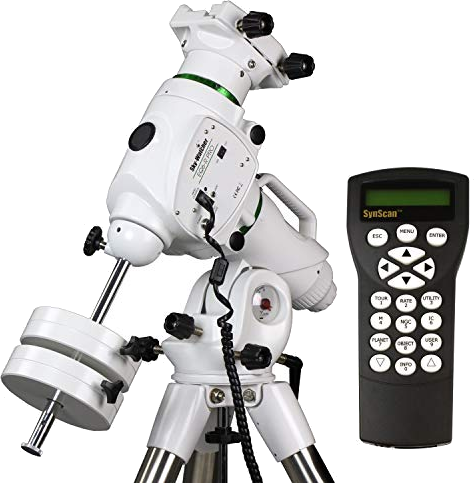
Equatorial GoTo Telescope Mount
- Belt-driven, motorized, German equatorial telescope mount with a payload capacity of 44 lbs (20 kg)
- Fully computerized with 42,900+ astronomical object database
- Most successful mount in the Astronomy Photographer of the Year competition in the last five years
- Most used mount in Astrobin's image database
Sky-Watcher HEQ5 Pro
Best Budget Sky-Watcher Mount
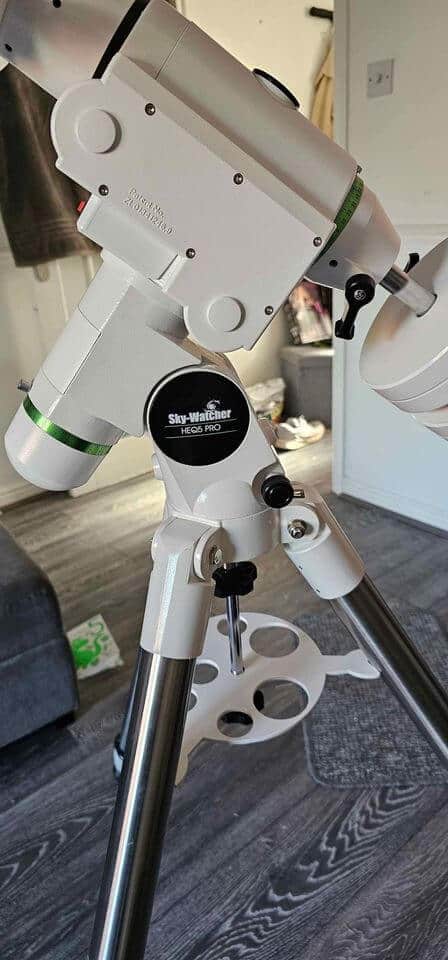
Our alternative pick is the Sky-Watcher HEQ5.
Cheaper than the EQ6-R Pro above, it makes for a more budget-friendly alternative.
It is in the top five telescope mounts used in the Astronomy Photographer of the Year competition and is the second most used mount in images on the Astrobin website, proving that it is a higher performer for astrophotography despite being lower-spec.
It boasts many of the same characteristics as the EQ6-R Pro (and the now-discontinued EQ6-R and NEQ6 Sky-Watcher mounts) in that it is a motorized GOTO equatorial mount that excels for astrophotography.
Its key difference is a lower payload capacity of 30 lbs. If your telescope, camera and other gear in your setup are within this then this is a perfect mount for you and can save you some money. You also have the bonus that this is a smaller and lighter mount than the EQ6-R Pro.
Pros
- It is a motorized GOTO equatorial mount – the best option for astrophotography.
- It has GoTo functionality using the included SynScan hand controller. With this you can get your telescope to automatically point to any of 42,000 astronomical objects.
- It also has a USB port so you can control it directly with a laptop or computer, enabling it to operate with alternative astronomy software.
- Its payload capacity is 30 pounds (13.6 kilograms), which should support many telescope and camera setups – check for you. The tripod and counterweights come included.
- It is lighter than many other premium mounts at a total setup weight including counterweights of 55 lbs (as opposed to 76 lbs for the EQ6-R Pro).
Cons
The only real downside to consider about this mount is that it has a lower payload capacity than the EQ6-R Pro at 30 lbs. However, if your setup is within this though then it is no problem.
Overall, this is a great astrophotography mount for beginners and even advanced users if their telescope weighs less than 30 lbs. It is proven to be successful for astronomy imaging from our data and makes a great option.
Key specifications
- Mount type: Motorized GOTO equatorial mount
- Payload capacity: 30 lbs (13.6 kg)
- Mount weight: 55.5 lbs (25.2 kg) (total weight for mount, tripod and counterweights)
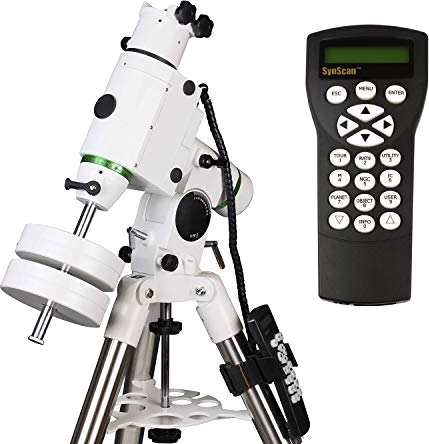
Equatorial GoTo Telescope Mount
- Motorized German equatorial telescope mount with a payload capacity of 30 lb (14 kg)
- Fully computerized with 42,900+ astronomical object database
- Top 5 most successful mount in the Astronomy Photographer of the Year competition in the last five years
- Second most used mount in Astrobin's image database
Celestron Advanced VX (AVX)
Best Budget Mount for Astrophotography
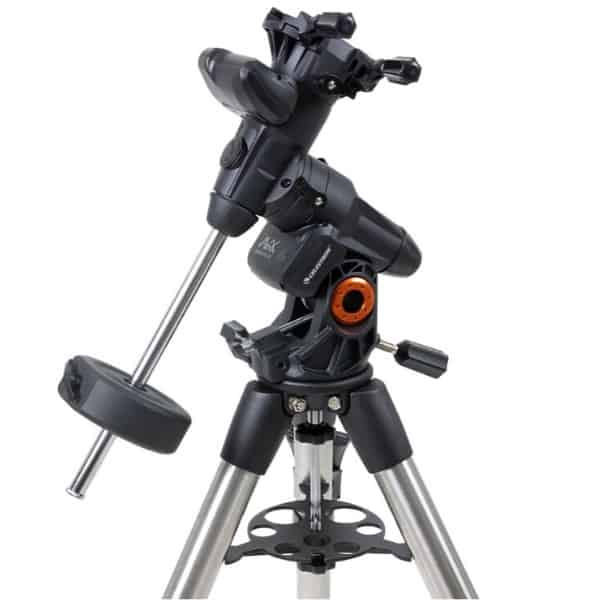
For a cheaper option still, our budget pick is the Celestron AVX.
This has most of the key attributes of a great mount for astrophotography and is used by a lot of successful astrophotographers but is significantly cheaper.
It has a smaller payload capacity of 30 lbs but this may be all you need, depending on your telescope setup.
Pros
- It has many similarities to the Sky-Watcher EQ6-R Pro above, in that it is a german equatorial GoTo mount and is operated via a hand terminal on which you can select objects from a database of 40,000 for it to find automatically.
- Polar alignment is done with help via the hand controller and in-built software.
- It has a payload capacity of 30 pounds (14 kg) which should suit many astrophotography setups.
- There is a USB port on the hand controller to enable it to be controlled via a computer.
- To take it to the next level of tracking accuracy it also has an autoguider port.
- It is relatively light (and significantly lighter than the EQ6-R Pro above) with a mount weight of 17 lbs.
See this video from Celestron for a quick overview of the main highlights.
Cons
Downsides to consider are:
- It’s worth calculating if the payload capacity is going to be enough for you and your particular telescope plus add-ons – remember for deep sky astrophotography you want to be plenty under the weight limit.
- To fit a telescope with D-Style (Losmandy) dovetail plates you need to buy a saddle upgrade.
Key specifications
- Mount type: Motorized GOTO equatorial mount
- Payload capacity: 30 lbs (14 kg)
- Mount weight: 35 lbs (16 kg)
Advanced VX Equatorial GOTO Mount
- The most compact and portable of Celestron's German equatorial mounts
- 30 lbs payload capacity
- Fully computerized with a database of 40,000+ astronomical objects and operated by hand controller
- Fourth most used mount in Astrobin images
Celestron CGX
Highest payload capacity
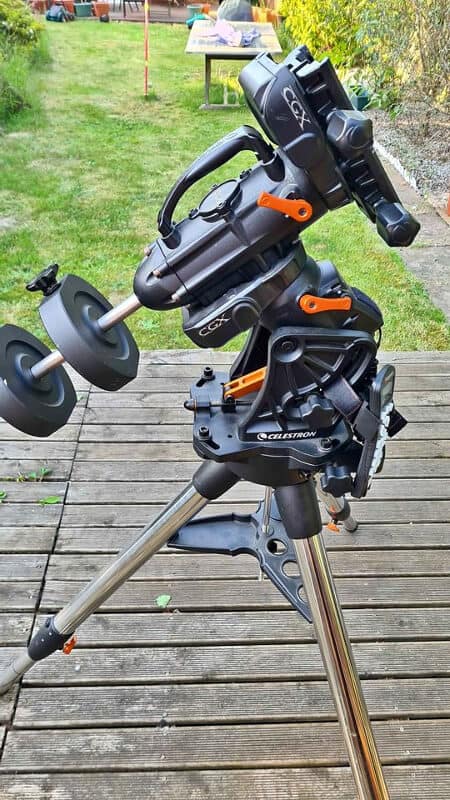
Our upgrade pick is the Celestron CGX.
Again, this has all the killer characteristics of a great astrophotography mount but what sets the CGX apart is the very high 55 lbs payload capacity, which is great for handling larger and heavier telescopes and setups.
Pros
- It boasts a whopping 55 lb payload capacity, which really opens it up to use with larger telescopes and deep sky set ups.
- It also ticks all the other boxes in terms of GOTO, usb connectivity, autoguider port etc.
See this video from Celestron for a quick overview of the main highlights.
Cons
The main downsides with this in comparison to our number one (the EQ6-R Pro) are:
- It costs more (check prices below),
- It weighs more and so is even less portable.
Key specifications
- Mount type: Motorized GOTO equatorial mount
- Payload capacity: 55 lbs (25 kg)
- Mount weight: 44 lbs (20 kg)
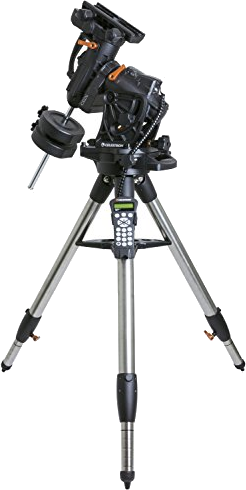
Computerized German Equatorial Mount and Tripod
- High 55 lbs payload capacity
- Fully computerized with a database of 40,000+ astronomical objects and operated by hand controller
- High-torque servo motors and belt-drive
Equatorial Mounts and Astrophotography
For beginners, you can understand telescope mounts by thinking of them as essentially tripods that move. They allow you (or a computer) to point your telescope where you want it to look and can allow you to track objects in the sky for long periods.
There are two main types of telescope mount, and then a range of key specifications that you will want to consider according to what is right for you. There are also specific considerations when thinking about what is best for astrophotography.
Types of telescope mount: EQ vs Alt-AZ
There are two main types of telescope mount:
- Equatorial mounts (also called EQ, and German Equatorial mounts or GEM),
- Alt-Azimuth mounts (also referred to as Alt-Az).
They are constructed differently and are operate differently: alt-az mounts move in two directions – up and down and side to side, whereas equatorial mounts can move at the full range of angles. The key thing that you need to know is that:
- Equatorial mounts are better for astrophotography
- Alt-Azimuth mounts are better for observing and astronomy
The reason that equatorial mounts are best for astrophotography is that they allow your telescope the full range of motion to allow them to smoothly track objects when imaging. Specifically, they move in the right direction and at the right speed to counteract the rotation of the Earth and the apparent movement of objects in the night sky.
Alt-Azimuth mounts only allow an up-down, left-right movement, and so there is a stepping motion when tracking objects through the sky. This is not smooth and will not work for the long-exposure imaging required for deep space photography.
However, Alt-Az mounts are much easier to use when observing with a telescope. Operating and pointing it where you want it to look is simple and intuitive. In contrast, EQ mounts can be ungainly and have heavy counterweights to balance the weight of the telescope.
What to Look For in a Mount for Astrophotography
So building on this we can look into the other characteristics of a great mount for astrophotography. Ideally we want these ten things:
- An equatorial mount (as outlined above).
- A high payload capacity – ensures that it can smoothly carry your telescope and accessories.
- Computerized or GOTO functionality – this is where the mount can automatically find and point at whatever it is you want to photograph (e.g. you press a few buttons and it finds the Andromeda galaxy for you). All of the mounts on this page have GOTO functionality.
- Reliable and accurate tracking – the key thing for obtaining great long exposures of deep space.
- Autoguiding capacity – some mounts allow you to connect an auxiliary guide scope and camera that improves the tracking accuracy by communicating with the mount to correct errors. This is great for taking your imaging to the next level.
- Portability – it depends on your circumstances but some will want to be able to easily move the mount and set it up quickly.
- USB connectivity – this allows you to directly connect a laptop or similar device to use to operate the mount rather than just the hand controller. This gives you the freedom to use different software of your choice.
- Compatibility – you need to make sure your telescope will be able to be connected (look for dual saddle plate support for both vixen and losmandy telescope types).
- Ease of use – you want your mount to be simple and easy to use so that it enables, rather than hinders, your nights’ spent imaging.
- In-built polar alignment – lastly, you want the process of polar alignment to be easy and reliable. Different mounts have different ways of assisting this.
Let’s now just look at a few key points of comparison for the mounts covered in this article.
Astrophotography Mount Payload Capacity Comparison Chart
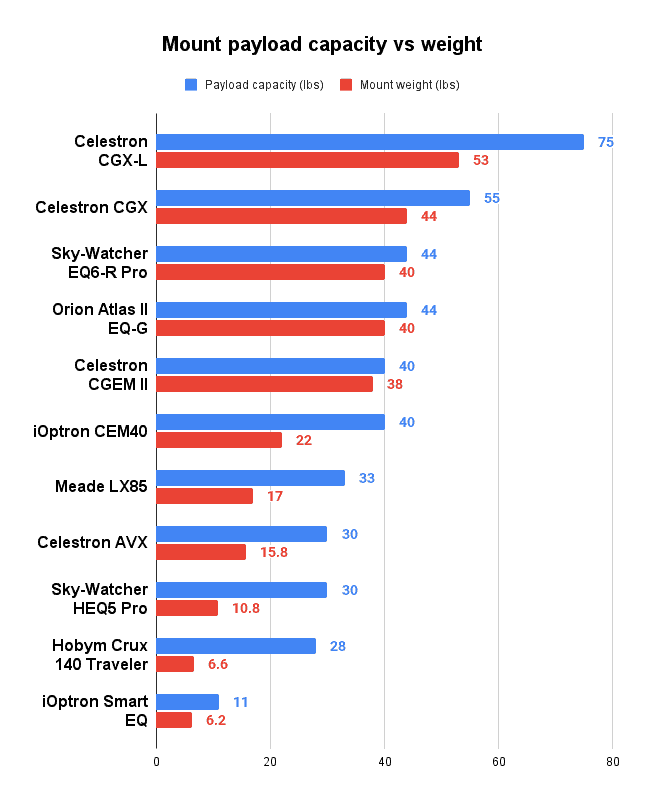
A relatively high payload capacity is needed to ensure that the mount can carry and move your telescope and other accessories that may weigh a lot.
In addition, it’s worth noting that the full payload capacity can be used for observing but you generally don’t want to be pushing your mount to its limit when imaging as this is when tracking errors are more likely to occur. In fact, some people recommend to only use about 50-60% of your mount’s capacity for astrophotography.
You therefore need to check the combined weight of the telescope, camera and any other equipment the mount will carry and make sure it is well within the payload capacity of the mount.
Here’s a chart comparing the payload capacities of all the leading astrophotography mounts mentioned on this page:
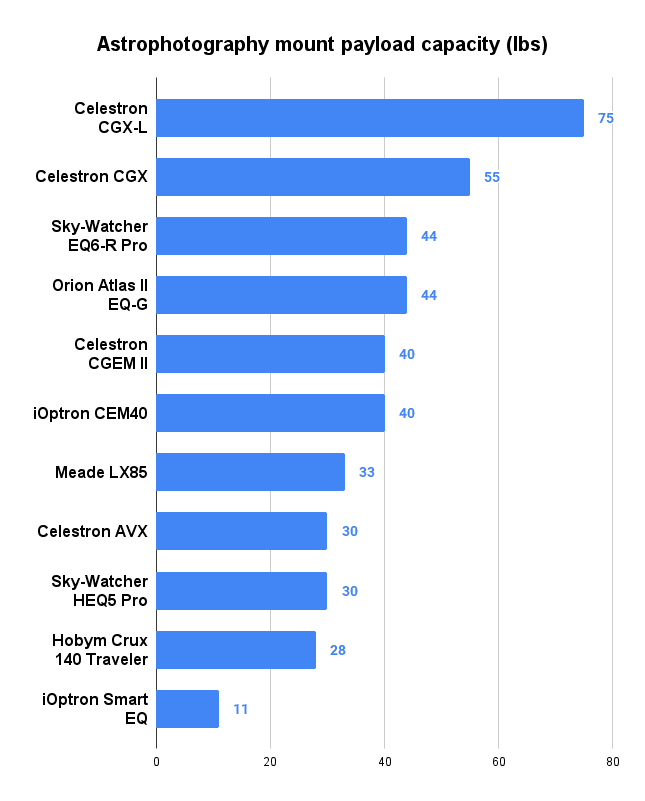
Note, we haven’t included the observatory level mounts as they are in a different league: Paramount ME II (220 lbs payload capacity) and Planewave L-600 (300 lbs payload capacity).
Astrophotography Mount Weight Comparison Chart
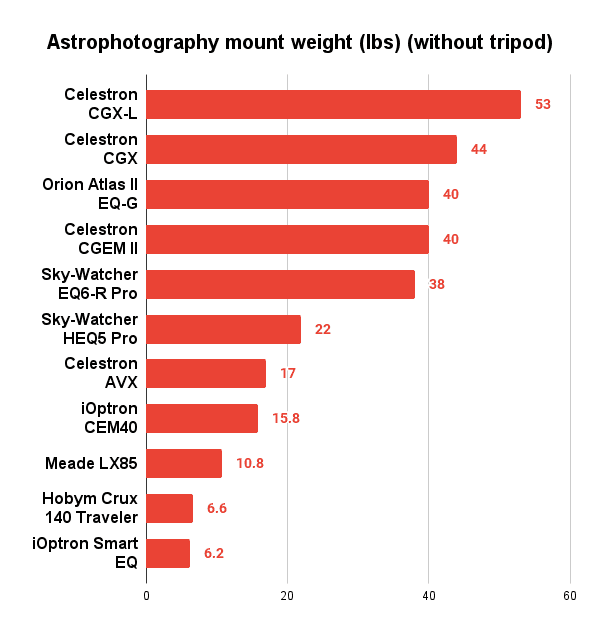
Another key thing worth considering is the weight of the mount.
As you can see there is a pretty substantial difference between the heaviest and lightest mounts and so is a factor in how you will use it. I.e. do you need it to be portable or will it likely stay fixed in one place?
Also, here is the payload capacity vs mount weight in one chart for ease of comparison:
Astrophotography Mount FAQs
What is the best mount for a heavy telescope?
The Software Bisque Paramount ME II Robotic Telescope System mount has an extremely large payload capacity of 220 lbs (100 kg) and so can take heavy telescope and camera setups.
This may be overkill for many though, and the Celestron CGX may provide enough with a capacity of 55 lbs (25 kg), or the Celestron CGX-L with 75 lbs (34 kg) for even heavier.
What is the most lightweight telescope mount option?
The Celestron AVX is a great, lightweight telescope mount.
One great alternative option, for a setup that is relatively lightweight, portable and affordable is to use a star tracker for the mount. Star trackers are great little pieces of equipment that sit between a tripod and a DSLR camera. They are mini motorized mounts that move the camera slowly in line with the rotation of the earth.
The good thing is that with small refractor telescopes, they are light enough that most star trackers can take their weight (with the addition of a counterweight). For instance, the iOptron SkyGuider Pro can take up to 11 lbs (5 kg).
Verdict: Best Telescope Mounts for Astrophotography
Ask any good astrophotographer and they will tell you that your mount is probably the most important piece of gear in your setup.
You have success with mediocre telescopes and cameras, but not with a bad mount. It needs to be tracking smoothly and accurately for great results.
In summary, from our findings our recommendations for the best telescope mounts for astrophotography are:
- The Sky-Watcher EQ6-R Pro is a proven astrophotography performer and in the intermediate price range
- The Sky-Watcher HEQ5 is a great alternative that is cheaper but has a lower payload capacity.
- If you cannot stretch to these or they are not available, then go for the Celestron AVX
- If you have the budget and value payload capacity over portability then go for the Celestron CGX or Celestron CGX-L
If you want computerized for less, see the Cheapest GOTO Equatorial Mounts.
Please let us know your views on this and whether you have any questions in the comments below.