With the UltraCat 76, William Optics celebrates its thirtieth anniversary by introducing a refractor that embodies the idea of continuous evolution.
The plug-and-play Petzval “Cat” philosophy here reaches full maturity:
- Five optical elements
- A native flat field
- An overhauled mechanical design, and
- A build quality that conveys excellence the moment you lift it from its case.
The UltraCat 76 promises to handle full-frame and even medium-format sensors with the same outstanding performance as its larger siblings, the UltraCat 91 and 108, while retaining the portability and simplicity of the legendary RedCat series.
“The perceived build quality, both visually and to touch, is exceptional”
Design & Construction – Engineering innovation
The UltraCat 76 is a masterful blend of optical engineering and precision mechanics.
Every component was designed with a clear goal: to deliver high, consistent performance over time while eliminating the most common issues of compact refractors intended for imaging.
At its core lies the Advanced Petzval 5-element optical group, entirely developed in-house by William Optics.
The combination of two Super-ED lenses, one ED, one Lanthanum, and one proprietary X-element ensures exceptional chromatic correction, high light transmission, neutral color rendition, and a fully corrected 50 mm image circle, wide enough to cover full-frame and even medium-format sensors without any additional flattener.
Mechanically, the scope retains the WIFD focuser, a system that shifts the focusing stage to the center of the optical tube, balancing the load and minimizing flexure and tilt.
Fully compatible with the ZWO EAF motor, it had already proven its worth on previous WO models.
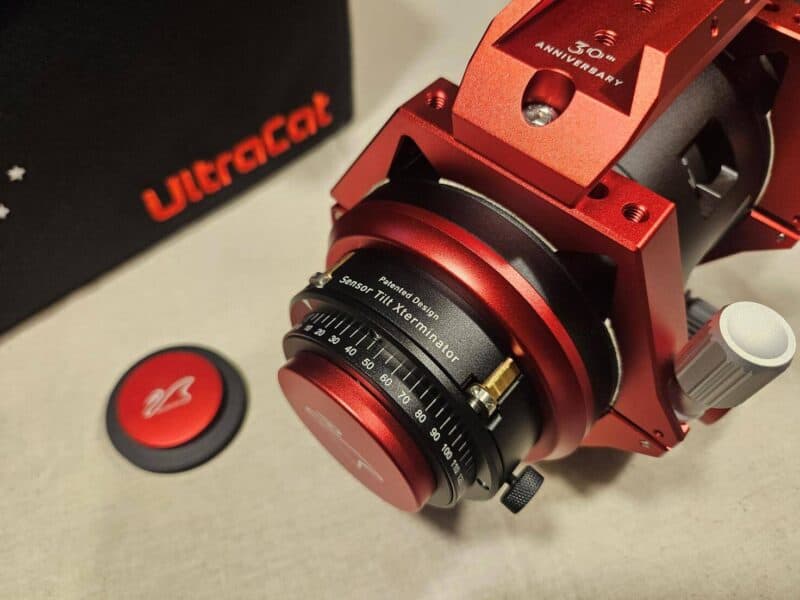
A further innovation is the Anti-Shrink Lens Cell, which uses elastic optical materials to compensate for thermal contraction at low temperatures.
This clever solution prevents “pinched optics,” maintaining perfect lens spacing and collimation even below –20 °C.
But the real mechanical revolution, the one marking a generational leap over the previous RedCat line, is the Sensor Tilt Xterminator (STX).
This built-in tilt-adjustment system allows corrections from the outside, without disassembling the imaging train.
Its eight-screw push-pull mechanism makes the procedure quick, intuitive, and extremely stable: loosen one screw, tighten the opposite, and the sensor is perfectly planar.
Combined with the WIFD focuser, it provides constant, repeatable flatness, turning the telescope into a single rigid, flex-free block.
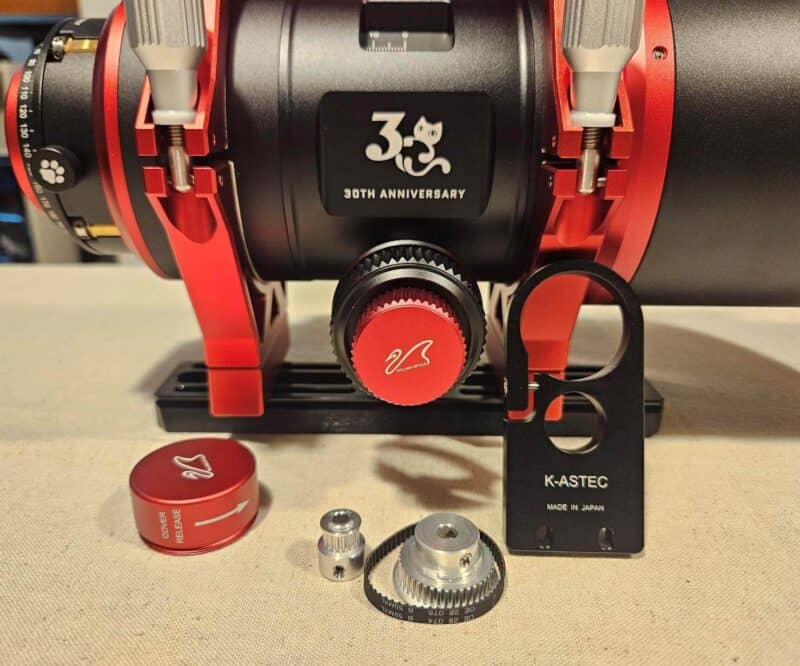
Completing the refined design are the Camera Angle Rotator, which enables smooth, precise field rotation for mosaics, and the front dust cap with integrated Bahtinov mask, allowing instant focus even on faint stars.
Overall, the UltraCat 76 exemplifies the balance between optical sophistication and mechanical innovation.
From its Advanced Petzval design to the WIFD focuser and the revolutionary STX, every feature aims to deliver a precise, reliable experience that fully leverages today’s high-resolution sensors.
At least, that’s the manufacturer’s claims, how does it perform in the field?
“Beautifully engineered, it stands confidently among far more expensive telescopes, small but with the heart of a true celestial predator.”
Unboxing & First Impressions
In the signature red-and-black UltraCat livery, the telescope arrives in a padded, well-finished carry case, with a numbered certificate and a quality-control checklist signed before shipping.
Inside you’ll find:
- Optical tube with 30th Anniversary CNC rings and engravings
- Vixen/Arca-Swiss dovetail bar
- Sensor Tilt Xterminator rotator
- Bahtinov-mask front cap
- UltraGuide 32 mm guide scope
- Optional K-Astec EAF kit (for ZWO EAF motor)
- Built-in thermometer
- M54 and M48 camera adapters with wrench
- Full Allen-key set
The perceived build quality, both visually and to touch, is exceptional: no plastic parts, minimal tolerances, flawless anodizing and markings throughout, and a sleek, elegant design.
Its compactness stands out immediately, enhanced by a retractable dew shield that slides smoothly with no play.
The tube diameter is generous, while overall length remains manageable.
The Vixen bar is finally robust and properly sized, unlike many undersized competitors, and the top mini-Vixen rail lets you attach multiple accessories beyond a simple guide scope.
The field rotator operates with reassuring solidity; once the tension screw is loosened, rotation is fluid and precise.
Both M54 and M48 adapters are included and easily installed with the supplied wrench.
The sample also came with a K-Astec EAF adapter, a Japanese-made premium accessory using a small belt drive to couple the ZWO EAF motor, silent, secure, and perfectly aligned.
After mounting the guide scope and EAF, I configured the imaging train with a ZWO CAA, a filter wheel, and the ASI 6200MM Pro camera.
I did note that to properly tighten the CAA, the large locking screw of the WO rotator had to be fully released, otherwise it blocked the thread. This raised a small concern about potential misalignment, an aspect I later verified during the optical tests.
Once everything was ready, I mounted the setup on my ZWO AM5N mount at my secondary pier, eager to begin field testing.
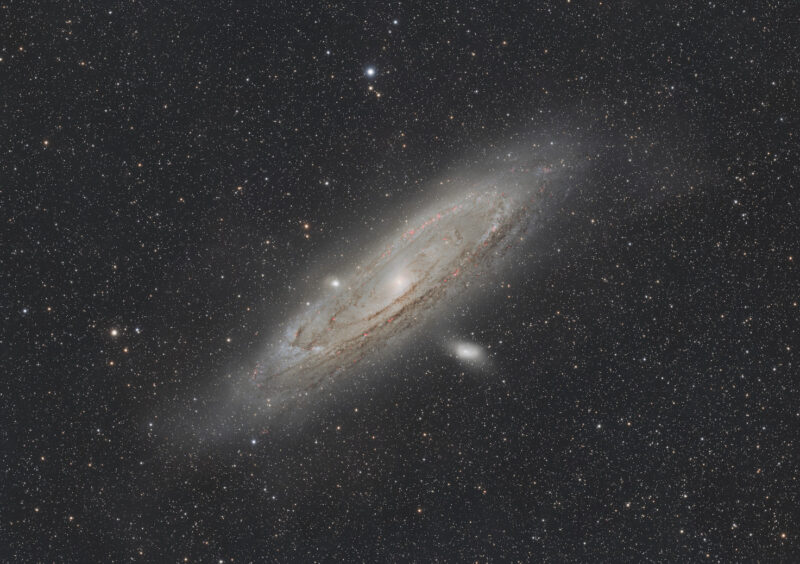
Field Test – William Optics UltraCat 76 (M31, Full Frame)
Setup & Acquisition:
- Optics: William Optics UltraCat 76 (365 mm f/4.8)
- Camera: ZWO ASI6200MM Pro (3.76 µm, full frame)
- Mount: ZWO AM5N
- Exposure: L × 60 | R/G/B × 30 each | O III × 65 | H α × 90 (all 300 s)
- Calibration: darks, flats, dark-flats
- Software: PixInsight
Testing and Fine Tuning
After the first test frames, I noticed a very slight tilt, nothing serious, but enough to test the new built-in adjustment system.
This was the perfect opportunity to try the Tilt-Xterminator, included with the telescope.
This mechanism is a huge improvement over the old RedCat design, which required disassembling the entire imaging train for every micro-correction.
Now, adjustments can be made externally, precisely and intuitively, without touching the camera or filter wheel, an enormous advantage, especially with full-frame sensors where even tenths of a millimeter matter.
After just a few minutes of micro-adjustment, I achieved perfect field flatness.
Subsequent frames confirmed the correction: stars were round and symmetrical across the sensor.
Clouds then interrupted the night, but over the following days I gathered a complete dataset on M31 – the Andromeda Galaxy, an ideal subject to evaluate sharpness, field curvature, chromatic correction, and illumination on a bright, wide field.
“Every component was designed with a clear goal: to deliver high, consistent performance over time while eliminating the most common issues of compact refractors intended for imaging.”
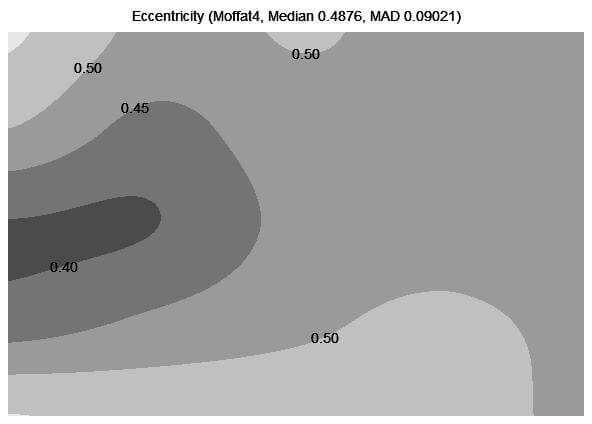
Stellar Shape Analysis – Eccentricity & FWHM
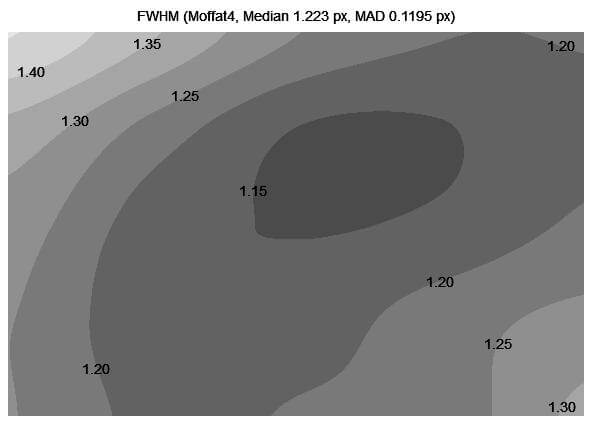
“Overall, the UltraCat 76 exemplifies the balance between optical sophistication and mechanical innovation.”
Results (Moffat4 profile)
- Median FWHM: 1.223 px ≈ 2.6″
- MAD FWHM: 0.1195 px ≈ 0.25″ → excellent uniformity
- Median Eccentricity: 0.4876 → very good
- MAD Eccentricity: 0.0902 → low dispersion
Interpretation
- The FWHM map shows consistent sharpness across the entire sensor: minimum 1.15 px at the center, edges between 1.20 and 1.30 px → no degradation at field limits.
- The eccentricity map remains stable (0.40 – 0.50), indicating circular stars and no residual tilt pattern.
Conclusion
- Exceptional sharpness and symmetry, after tilt adjustment, the optics perform flawlessly.
Field Flatness / Curvature / Tilt – Aberration Inspector
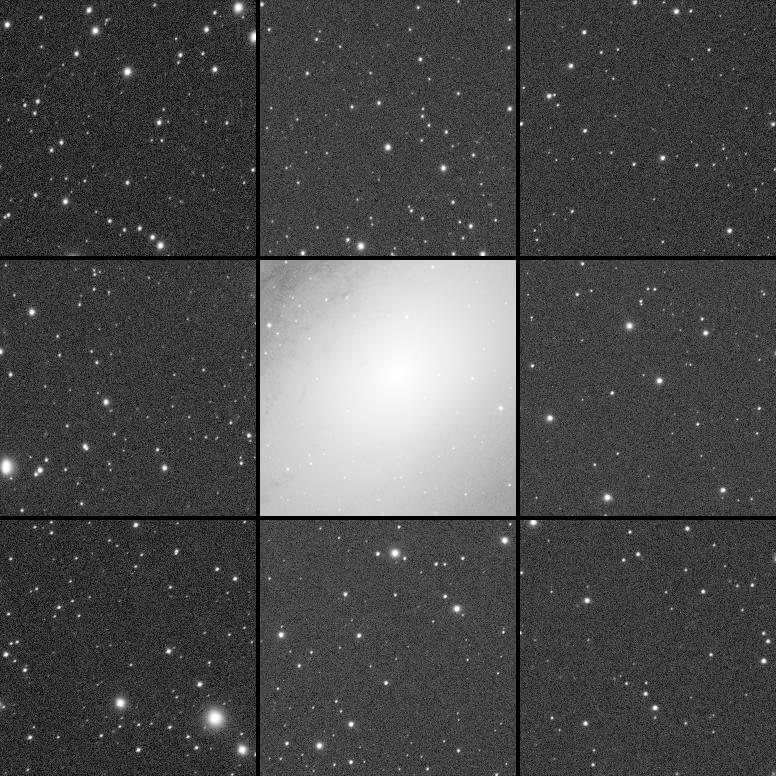
Observations
- The central panel (M31 core) shows stars perfectly round, no elongation or astigmatism.
- In the outer tiles, stars remain circular with only mild radial stretching (0.2–0.4) toward the center—typical of a well-corrected Petzval field.
- All four corners behave symmetrically, confirming no mechanical tilt and excellent collimation.
Summary Diagnosis
- Field curvature: minimal, well controlled
- Tilt: absent (< 2 %)
- Collimation: excellent, consistent with FWHM/Eccentricity data
Conclusion
- A flat, stable field across 36 × 24 mm — the UltraCat 76 is fully compatible with modern full-frame high-resolution sensors.
“The UltraCat 76 is a compact yet professional instrument, ideal for deep-sky wide-field imaging, high-resolution mosaics, and full-frame sensors.”
Chromatic Correction – RGB
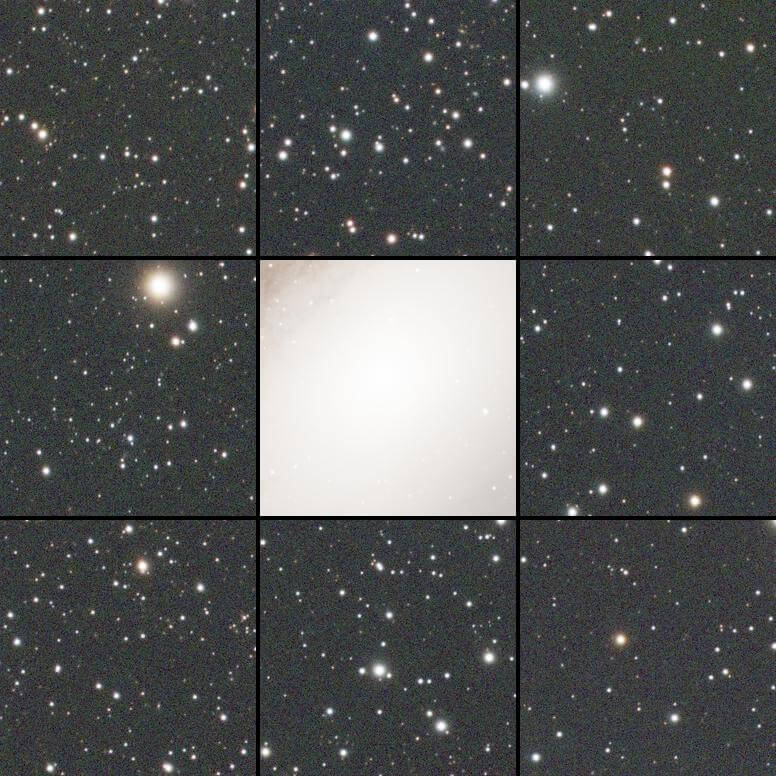
- Center: Stars appear white, neutral, and pinpoint, even around the bright core of M31 → excellent optical alignment and apochromatic correction.
- Edges & Corners: Color and focus remain consistent. No blue/magenta or yellow-green fringing observed. Only the brightest stars in the extreme corners show a slight bluish tint, fully acceptable for a field of this size.
- Conclusion: Color correction is outstanding and uniform: the UltraCat 76 behaves as a true high-end apochromat, ideal for pure RGB work and natural-color imaging.
Illumination & Vignetting – FlatContourPlot
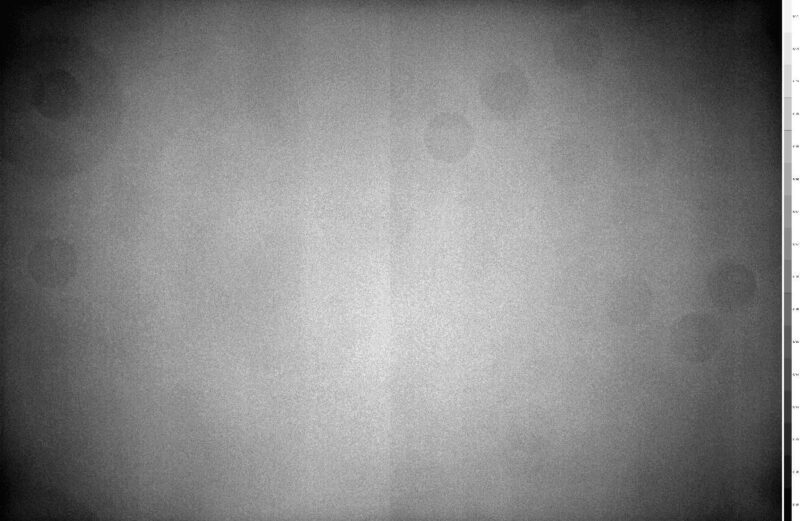
- Illumination is highly uniform, with only 15–20 % edge fall-off, excellent for an f/4.8 Petzval on a full-frame sensor.
- The center is perfectly symmetrical, with no hotspot or diagonal gradients.
- A few soft dust motes appear (upper-right / upper-left quadrants), caused by small particles on filters or protective glass, easily removed through calibration.
Conclusion
- Vignetting is well-controlled, illumination even and centered.
- The optical train is well aligned and perfectly suitable for large-format sensors.

Final Summary
Comprehensive testing confirms that the William Optics UltraCat 76 achieves top-tier optical and mechanical performance:
| Parameter | Result | Rating |
|---|---|---|
| ParameterMedian FWHM | 1.223 px (~2.6″) | ⭐⭐⭐⭐⭐ |
| Field Uniformity (MAD) | 0.12 px | ⭐⭐⭐⭐⭐ |
| Median Eccentricity | 0.49 | ⭐⭐⭐⭐ |
| Curvature / Tilt | Negligible | ⭐⭐⭐⭐⭐ |
| Chromatic Correction | Apochromatic | ⭐⭐⭐⭐⭐ |
| Vignetting | 15–20 % symmetric | ⭐⭐⭐⭐ |
Overall Impression
The UltraCat 76 behaves like a modern, evolved 5-element Petzval:
- A perfectly flat field
- Neutral color rendition
- Pinpoint stars
Setup and collimation are simple thanks to the new Tilt-Xterminator, which allows quick, accurate sensor alignment.
Paired with the ZWO AM5N mount, the telescope showed excellent tracking stability and ease of operation, fully exploiting the precision of the optical system.
In conclusion, the UltraCat 76 is a compact yet professional instrument, ideal for deep-sky wide-field imaging, high-resolution mosaics, and full-frame sensors.
Beautifully engineered, it stands confidently among far more expensive telescopes, small but with the heart of a true celestial predator.
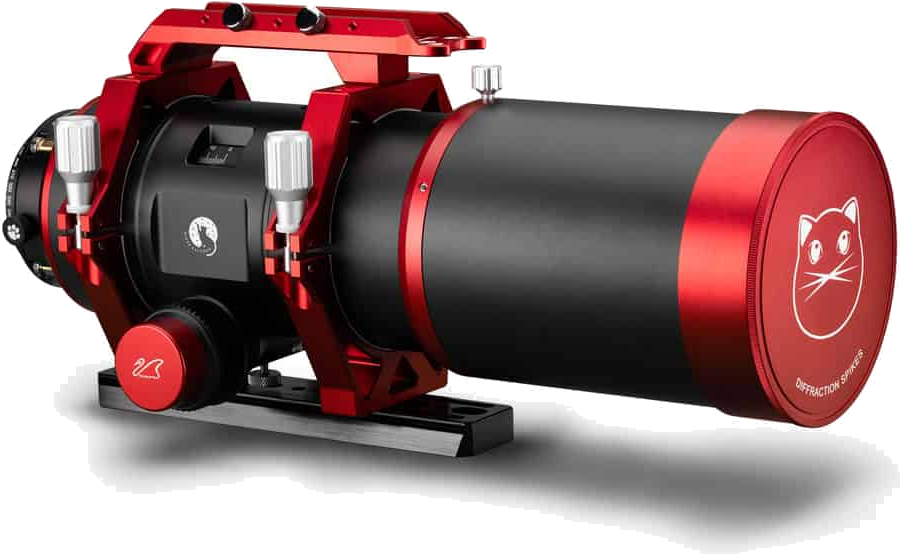
Quintuplet Apochromatic Refractor Telescope for Astrophotography
- Perfectly flat field on full-frame sensors
- Stable, well-balanced WIFD focuser
- Integrated, intuitive STX tilt system
- No external field flattener required
- Excellent build quality and finish
- Compact, portable design
- Slightly heavier than the RedCat 71
- Limited availability (30th Anniversary Edition)
Technical Summary
- Aperture: 76 mm
- Focal length: 365 mm
- Focal ratio: f/4.8
- Optical design: 5-element Advanced Petzval
- Image circle: 50 mm
- OTA weight: 3.81 kg
- Compatibility: Full Frame / Medium Format / APS-C
- Focuser: WIFD R&P Internal Focuser (EAF Ready)
- Rotator Sensor: Tilt Xterminator + Camera Angle Rotator
- Mask: Integrated Bahtinov mask in optical PMMA
Pros and Cons
Pros:
- Perfectly flat field on full-frame sensors
- Stable, well-balanced WIFD focuser
- Integrated, intuitive STX tilt system
- No external field flattener required
- Excellent build quality and finish
- Compact, portable design
Cons
- Slightly heavier than the RedCat 71
- Limited availability (30th Anniversary Edition)
Author: Simone Curzi

- Astrophotographer – ShaRA Team & Associazione Astrofili Forca Canapine
- Organizer of the Sibillini AstroFest
- Judge for ZWO ASI – AstroIMG
- PixInsight Instructor
Contact/Follow Simone: