Pentax is one of the leading manufacturers of photography equipment, but what about Pentax Astrophotography?
In this article, we dig into the best Pentax cameras and lenses for astrophotography and investigate Pentax’s Astrotracer functionality.
Let’s get into it.
Best Pentax Cameras for Astrophotography
Best Overall 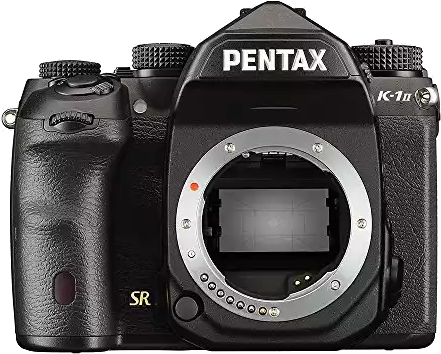 | Best Budget 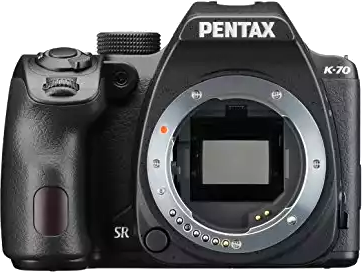 | 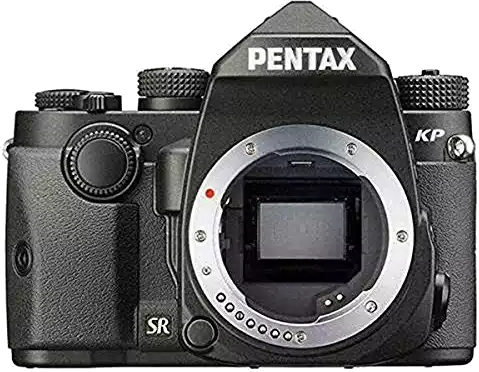 | 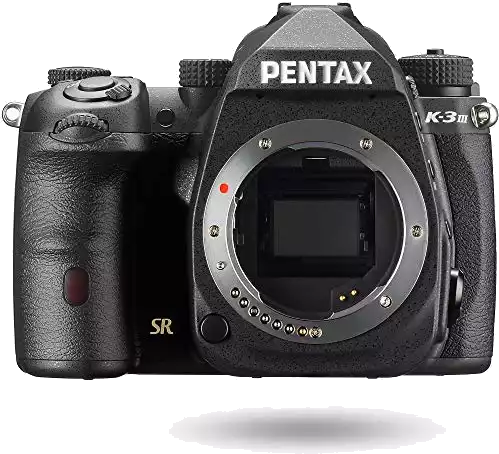 |
Make & Model: Pentax K-1 Mark II | Make & Model: Pentax K-70 | Make & Model: Pentax KP | Make & Model: Pentax K-3 Mark III |
Type: DSLR | Type: DSLR | Type: DSLR | Type: DSLR |
Sensor: Full-frame | Sensor: APS-C | Sensor: APS-C | Sensor: APS-C |
Sensor size: 36 MP | Sensor size: 24 MP | Sensor size: 24 MP | Sensor size: 25 MP |
Year of release: 2018 | Year of release: 2016 | Year of release: 2017 | Year of release: 2021 |
Pentax K-1 Mark II
Best Pentax camera for astrophotography
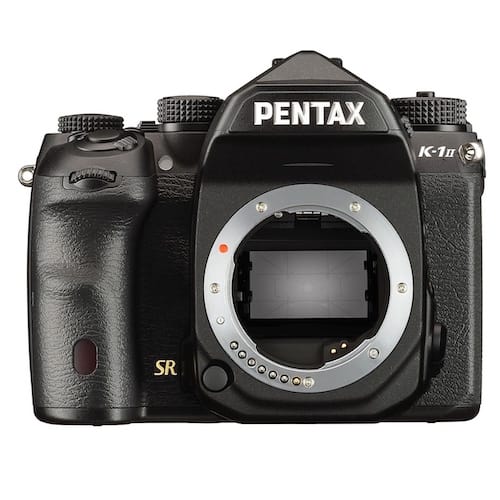
The Pentax K-1 Mark II is their flagship full-frame DSLR and was released in 2018. We regard it as the best Pentax camera for astrophotography.
The decisive factor is the full-frame sensor, which is a key specification for astrophotography. We delve into this more in our article on the best cameras for astrophotography but, in short, full-frame sensors:
- Perform better in low light, and
- Enable you to capture a wider expanse of the sky (important for landscape astrophotography and getting those images of the Milky Way above the earth that we all want).
This camera is one of the few DLSRs available from any manufacturer that has dedicated astrophotography modes available. In particular, its built-in GPS enables its Astrotracer functionality. You can read more about Astrotracer below but essentially it allows you to take much longer exposures of the night sky without getting star trails and replacing the need to add an external star tracker.
In addition, another internal function available on the camera is its Starstream mode. This creates 4K timelapse videos of the night sky that require very little, if any, editing or post-processing.
The camera is also weatherproof, which is a great advantage given that for astrophotography you often need to travel to locations with less light pollution away from cities and the rain and the elements may catch you out.
It has a night mode on its screen so that you can use it without ruining your night vision and it has lights inside the camera to help you operate at night (for example, in the card slot).
Another bonus for the astrophotographer is the fully articulating screen which can be really helpful for composing shots at night at awkward angles.
It has a 36.4-megapixel resolution and an extremely high ISO range that goes up to 819,200.
In summary, this is a great DSLR for astrophotography and, we believe, the best option from Pentax’s range.
Key specifications
- Camera type: DSLR
- Sensor type: Full-frame
- Sensor size: 36 MP
Pentax K-70
Best beginners’ Pentax camera for astrophotography
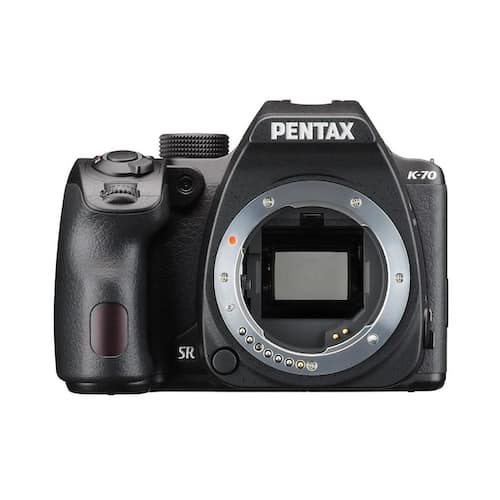
The Pentax K-70 is a great beginner’s camera for astrophotography and a real bargain.
One of the main features that distinguishes it from entry-level equivalents from Nikon or Canon is that it is weather-proof, and so tailored for outdoor photography.
Other great pros of this camera are:
- It has a feature called pixel shift resolution that can help take sharper images over long exposures
- It has a fully articulating screen – great for composing astro shots
- It’s relatively cheap in comparison to other Pentax models of similar specifications
It does not have an in-built GPS, which means that the Astrotracer function is not available as standard, but you can add the Pentax O-GPS1 unit to give it this functionality.
In short, the K-70 is about as good as it gets for entry-level crop sensor DSLRs for astrophotography and can be a real bargain.
Key specifications
- Camera type: DSLR
- Sensor type: APS-C
- Sensor size: 24 MP
Pentax KP (vs K-70)
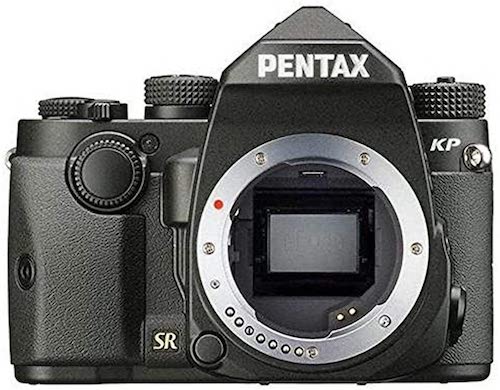
The Pentax KP is very similar in many ways to the K-70:
- DSLR
- APS-C crop sensor
- 24 MP sensor size
However, it generally costs twice as much as a K-70 and there seem to be few advantages of the KP over the K-70. One thing is improved autofocus, but this is not something you will use for astrophotography as you will always be manually focusing. This may be a positive though if you plan to use the camera for other day-to-day photography.
There are some advantages of the K-70 over the KP though:
- It has a fully articulating screen, rather than just a tilting screen
- It is smaller and lighter
- It has a better battery life
- It’s cheaper (although check the live prices by clicking the links on this page)
In short, for astrophotography there is little the KP can do better than the K-70 and so we would regard the K-70 as better value.
There is a good video here that gives a brief overview of the K-1 Mark II, the K-70, and the KP for astrophotography:
Pentax K-3 Mark III (vs KP vs K-70)
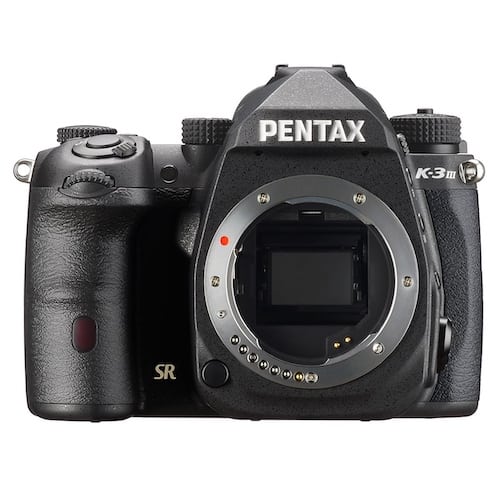
The last model that we wanted to touch on was the brand new Pentax K-3 Mark III, which was released in mid-2021.
It is branded as Pentax’s “flagship” crop sensor camera (with the K-1 Mark II as the flagship full-frame model). Again though it is very similar in terms of the key specifications to the K-70 and KP:
- DSLR
- APS-C crop sensor
- 25 MP sensor size
It does have some advantages over these other models, in particular:
- It has the Astrotracer functionality built-in
- It is a better and fully up-to-date all-round camera for other types of photography
The major downside though is the cost. At the time of writing it was retailing for about the same price as the full-frame K-1 Mark II.
In our opinion for this money (and with our astrophotography hats on), most people would be better off going for either a much cheaper K-70 and adding the external GPS unit for Astrotracer functionality, or going straight for the full-frame K-1 Mark II.
What is Pentax Astrotracer?
A number of Pentax models have a mode that can be used called Astrotracer. What this does is shift the sensor inside the camera so it adjusts to compensate for the rotation of the Earth when shooting.
This is a major thing for astrophotography as you generally want to shoot for as long as possible to capture as much light as you can, but are limited on how long you can do this by the rotation of the earth as the stars begin to lose their sharpness and start to trail after a certain amount of time (depending on what camera and lens focal length you are using).
Therefore Astrotracer allows longer exposures without star trails and increases the chances of getting great shots without needing to take multiple shots and stack them in post-processing.
This is essentially what a separate piece of equipment known as a star tracker does, but the Astrotracer functionality builds a version of this into the camera and so makes having this extra piece of equipment between your tripod and camera unnecessary.
Here is a video from one Cuiv the Lazy Geek (one of the best astrophotography YouTubers) that gives a good overview of the Astrotracer functionality:
Which Pentax cameras have Astrotracer?
The Pentax camera models which have the Astrotracer functionality in-built are the:
- Pentax K-1
- Pentax K-1 Mark II
- Pentax K-3 Mark II
- Pentax K-3 Mark III
This is because these are the models that have in-built GPS units.
Pentax O-GPS2 Astrotracer
You can add the Astrotracer functionality for other Pentax models by buying the separate Pentax O-GPS2 unit that attaches to the top of your camera.
Some more information on the O-GPS2 can be found on Ricoh’s site.
Astrotracer vs Star Trackers
There are a number of advantages to using in-built Astrotracer versus using an external star tracker:
- You don’t need to buy, carry and think about powering another piece of equipment.
- It avoids you having to go through the process of polar alignment (required with star trackers). Astrotracer requires just some simple calibration.
- It reduces the total weight on your tripod, meaning that you can get away with a lighter, compact travel tripod.
- If you are caught without a tripod or just want to take a quick shot of the night sky, you can place the camera on the floor and use the Astrotracer mode. You can’t get by without a tripod when using a star tracker.
There’s a good overview of this translated from Japanese on Pentax’s site.
Best Pentax Lens for Astrophotography
For astrophotography, and landscape astrophotography in particular, you want to use a wide-angle lens (to capture a wide expanse of the night sky) with a fast aperture (to better work in low light and capture the stars).
We recommend two great lenses to use with your K-Mount cameras for Pentax astrophotography:
Let’s look at each in more detail.
Samyang 14mm F/2.8 Lens for Pentax
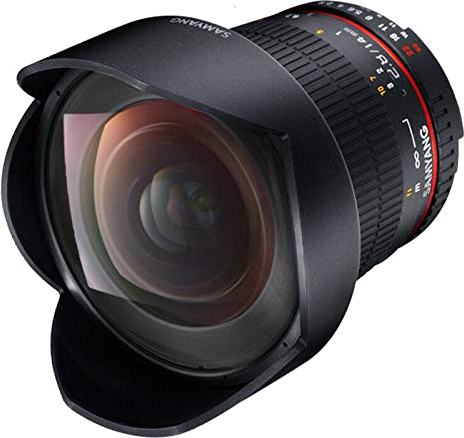
The Samyang 14mm F2.8 is designed for both Full-Frame and APS-C Pentax cameras, and this budget ultra-wide-angle manual focus lens is one of the most popular lenses for astrophotography.
Key features include:
- Ultra Wide Angle: 14mm, 115.7° ultra-wide angle allows you to capture the vastness of the night sky
- F2.8 Aperture: F/2.8 aperture is great for low-light photography. It allows sufficient light to hit the sensor, capturing the faintest stars and the subtle glow of distant galaxies. Even wide open, the image quality remains superb, making it perfect for landscapes under the stars.
- Manual Focus: For astrophotography, you will only be using manual focus to pinpoint the stars as autofocus cannot be relied upon for this
- Smooth Focus Ring: The wide, ribbed manual focus ring is smooth and well-damped, allowing precise control. This is helpful when focusing on distant stars, making it an ideal choice for night shooting.
- High Build Quality: The built-in petal-shaped lens hood and solid construction makes it feel robust and ready for outdoor adventures.
- Beautiful Bokeh: Though not a primary feature for astrophotography, the 6 rounded blades create a soft and pleasing bokeh. It adds an artistic touch to foreground elements, such as trees or rocks, against the night sky.
- Versatility and Affordability: Beyond astrophotography, this lens is well-suited for landscapes, architecture, and videography. Its excellent price advantage makes it accessible to both professionals and amateurs.
Sigma 18-35mm F1.8 Art Lens for Pentax
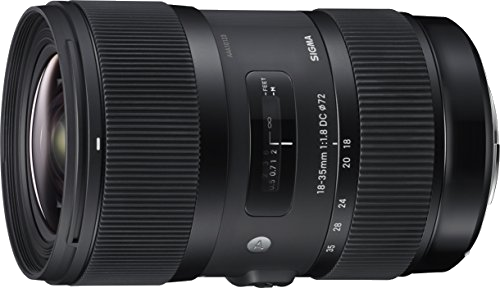
This is the more expensive option but for this you get the faster f/1.8 aperture and the flexibility of the 18-35mm zoom. Note, it is designed for APS-C sensor cameras only.
Key features include:
- F1.8 Aperture: The constant F1.8 aperture allows you to capture stunningly bright and sharp images of celestial objects. Whether zooming in on a distant galaxy or capturing a wide field of stars, the lens’s performance remains consistent and impressive.
- Versatility and Performance: The 18-35mm focal length range provides the flexibility to cover angles of view offered by multiple large-aperture, fixed focal length lenses.
- SLD Glass and Aspherical Lens Elements: The use of SLD (Special Low Dispersion) glass and aspherical lens elements ensured minimal chromatic aberration and distortion. The stars appear pinpoint sharp, and the colors are true to life.
- Autofocus and Versatility: Though manual focus is preferred in astrophotography, autofocus is handy for other photography use.
- Bokeh: The rounded diaphragm creates a pleasing bokeh effect, adding an artistic touch to foreground elements.
- Build Quality and Ergonomics: The lens feels robust and well-built, ready for outdoor adventures under the stars. The high-precision, rugged brass bayonet mount added to its durability. Its weight of 810g (28.6oz) is manageable, making it comfortable to use during long night sessions.
- Accessories and Protection: The supplied petal-type lens hood, front and rear caps, and case ensured that the lens was well-protected. The availability of separately sold accessories like water-repellent and antistatic filters added to its usability.
See the best lenses for astrophotography for more on this topic.
Pentax Astrophotography FAQs
Are Pentax cameras good for astrophotography?
Pentax cameras are just as good at astrophotography as other major DSLR brands.
What Pentax cameras have an Astrotracer?
The Pentax cameras that have Astrotracer are the Pentax K-1, Pentax K-1 Mark II, and Pentax K-3 Mark III.
Final word on Pentax Astrophotography
In summary, we believe that:
- The Pentax K-1 Mark II is the best Pentax camera for astrophotography. It has a full-frame sensor and has the Astrotracer mode built in.
- The Pentax K-70 is the best Pentax model for astrophotography beginners. It’s a great entry-level camera, its cheap and you can add the GPS unit to get the Astrotracer mode.
Both of these cameras are weather-sealed, rugged, and tough, articulating screens. They also have good lens options for astrophotography.
While the Pentax KP and Pentax K3 Mark III are great cameras, we see little to recommend them (for astrophotography) above these two models.
We hope you found this overview useful. Let us know in the comments below if you have any questions or thoughts on this.