The Celestron NexStar computerized telescopes are some of the most popular on the market and there are 11 models in the range:
- Three in the SLT category
- Four in the SE category
- Four in the Evolution category
But of these telescopes, what are the differences and which one is right for you? Below we assess them all and outline the pros and cons of each.
Celestron NexStar SLT Telescopes
Budget Make & Model: Celestron NexStar 90SLT | Compact Make & Model: Celestron NexStar 127SLT | Powerful Make & Model: Celestron NexStar 130SLT |
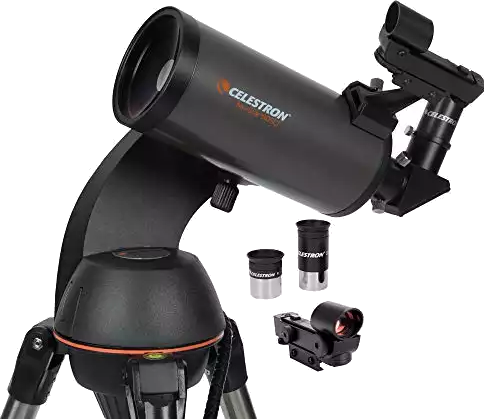 | 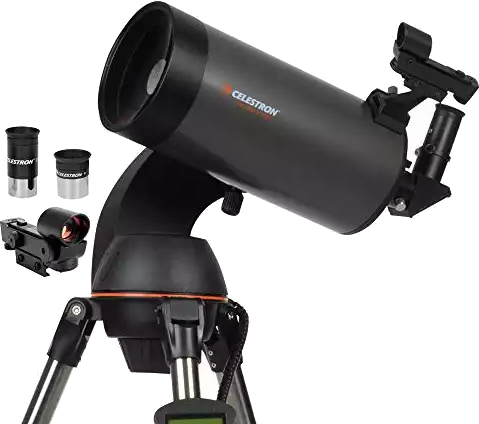 | 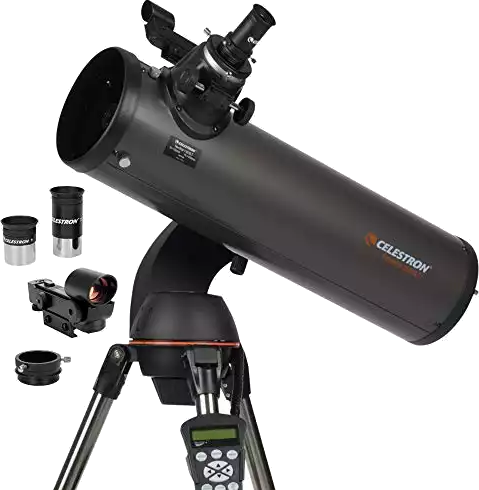 |
Telescope type: Maksutov-Cassegrain | Telescope type: Maksutov-Cassegrain | Telescope type: Newtonian Reflector |
Aperture: 90 mm (3.5 inch) | Aperture: 127 mm (5 inch) | Aperture: 130 mm (5 inch) |
Focal length: 1250 mm (49 inch) | Focal length: 1500 mm (59 inch) | Focal length: 650 mm (26 inch) |
Weight: 12 lbs (5.4 kg) | Weight: 20 lbs (9 kg) | Weight: 31.5 lbs (14.3 kg) |
Star Location Telescopes
“SLT” stands for “Star Location Telescope”.
The numbering in the names of each model – 90, 127, 130 – refers to the aperture of the telescope as measured in millimeters (rather than in inches, for the SE and Evolution telescopes below).
These are a range of refractors, reflectors, and catadioptric (Maksutov Cassegrain) telescopes. This just refers to how the telescopes are built – refractors use glass, reflectors use mirrors, and catadioptric use both. What is best for you depends on your circumstances.
Like all of the NexStar telescopes, they come as a full bundle that includes the telescope tube, computerized mount and tripod.
These SLT telescopes are mostly aimed at beginners and are the most “entry-level” of the different NexStar types – i.e. they are the cheapest but the most limited in terms of astronomy viewing capacity.
Having said that, they are very good telescopes for casual users and boast of being relatively small, portable, and easy to store.
Some basics of the NexStar SLT range are covered in this Celestron video:
Celestron NexStar 90SLT
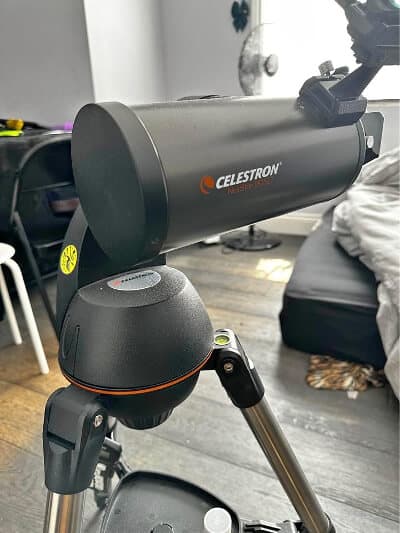
The NexStar 90SLT is the smallest and lightest of all the NexStar telescopes.
It has a 90mm aperture telescope tube, which is the lowest of the range, but plenty large enough for good viewing.
Notably, it has a relatively high focal length (1250mm) which is a result of the internal (catadioptric) design that combines glass and mirrors and effectively means that it will be very good at zooming in to view objects like the moon and the planets of our solar system like Mars.
This is something to consider based on your preferences – high focal length means a narrower field of view, so better for getting close to objects that are relatively close to us (like the moon and planets), but less good for viewing large and far off deep sky objects like galaxies and nebulae.
This makes for a good low-budget option and is possibly the cheapest computerized telescope package from a reliable manufacturer on the market.
It would suit perhaps a family to have fun with together and maybe take photos with a smartphone adapter, or someone with limited storage space at home.
Pros
- Relatively cheap for a computerized telescope package
- As a catadioptric telescope it is small and compact. This is a great quality if you are short on space at home to use and store it.
- It is battery-powered and portable – powered by 8 AA batteries or a portable PowerTank.
- Good for viewing the moon and planets.
- GOTO mount can locate objects for you at the press of a button.
- Includes all accessories needed to get going right away.
Cons
- At 90mm it has the lowest aperture (power) of any NexStar telescope.
- Limited capacity for viewing deep sky objects.
- Limited astrophotography capability.
Key specifications
- Type: Catadioptric (Maksutov-Cassegrain)
- Aperture: 90mm (3.5-inch)
- Focal Length: 1250 mm (49 inch)
- Focal Ratio: F/14
- Weight: 12 lbs (5.4 kg)
- Accessories: Red dot finderscope, star diagonal, two eyepieces (25mm and 9mm)
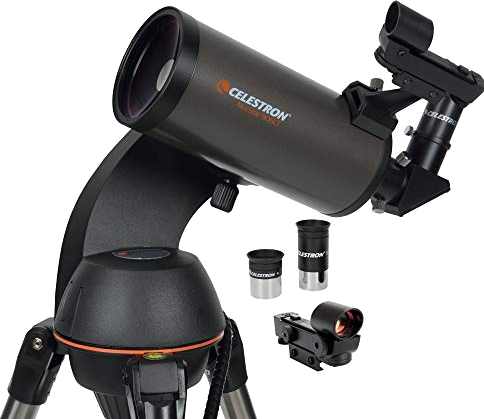
Compact Computerized Telescope
- The Celestron NexStar 90SLT is a computerized telescope that offers a database of more than 40,000 stars, galaxies, nebulae, and more. The telescope locates your object with pinpoint accuracy and tracks it.
- This telescope for adults and kids to be used together is ideal for weekend camping trips or excursions to dark sky sites. Its compact form factor makes it easy to transport and assemble just about anywhere.
- The 90mm aperture gathers enough light to see our Solar System and beyond. View Saturn’s rings, Jupiter’s cloud bands, and the Moon in brilliant detail.
Celestron NexStar 127SLT
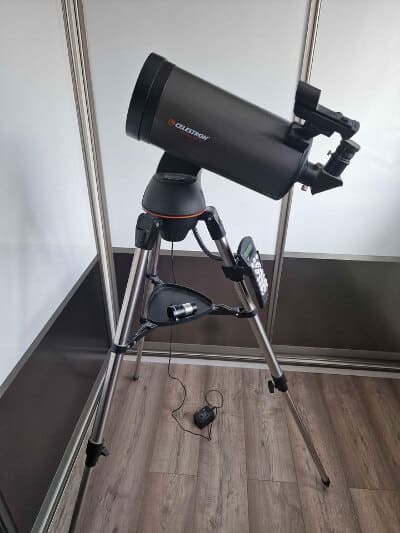
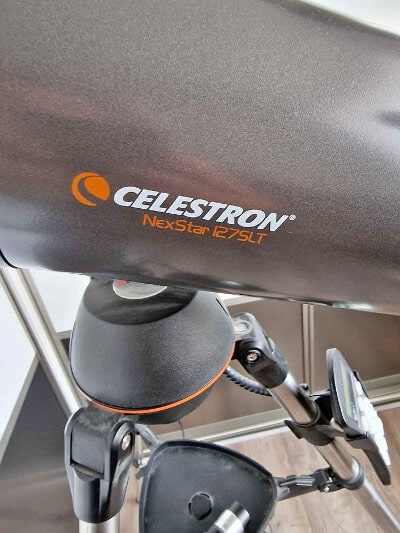
The third model is the 127SLT. This is essentially a bigger and better version of the 90SLT.
This is catadioptric like the 90SLT but has a considerably higher aperture at 127mm (5 inches) for much better viewing.
The downside would be that it costs more and is considerably heavier.
Pros
- Higher aperture at 5-inches.
- Small and portable.
- Long focal length for good viewing of the moon and planets.
- Battery-powered and portable – powered by 8 AA batteries or a portable PowerTank.
- GOTO mount can locate objects for you at a press of a button.
- Includes all accessories needed to get going right away.
Cons
- Nearly twice as heavy as the 90SLT.
- Limited astrophotography capability.
Key specifications
- Type: Catadioptric (Maksutov-Cassegrain)
- Aperture: 127 mm (5 inch)
- Focal Length: 1500 mm (59 inch)
- Focal Ratio: F/12
- Weight: 20 lbs (9 kg)
- Accessories: Red dot finderscope, star diagonal, two eyepieces (25mm and 9mm)
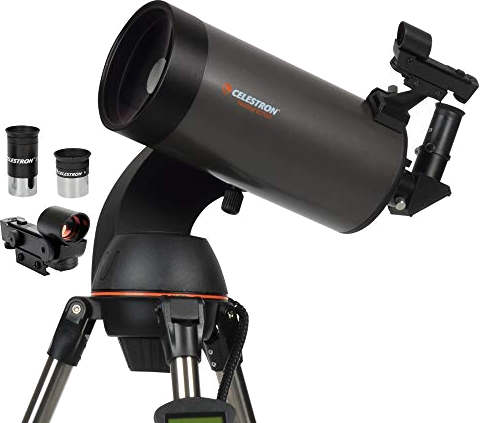
5-inch Aperture Maksutov-Cassegrain Computerized Telescope
- The 5-inch (127mm) aperture gathers enough light to see our Solar System and beyond. View Saturn’s rings, Jupiter’s cloud bands, and the Moon in brilliant detail.
- This computerized telescope has a database of more than 40,000 stars, galaxies, nebulae, and more. The telescope locates your object with pinpoint accuracy and tracks it.
- Small, compact, easy to assemble and easy to transport.
Celestron NexStar 130SLT
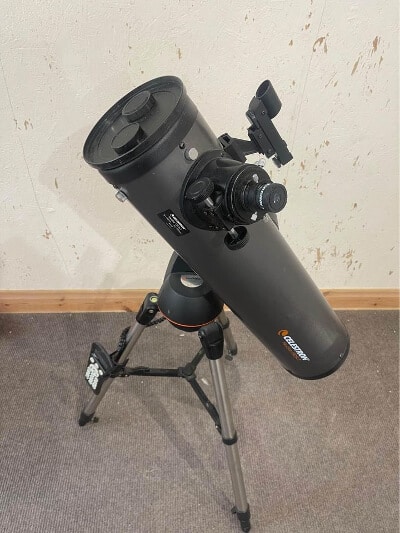
The last in the SLT range is the 130SLT. Again, the name refers to the 130mm (5 inch) aperture telescope tube.
With its aperture and focal length, there is little limit on what you can see through this if the night sky conditions are right.
This is a reflector telescope. These tend to be bigger and bulkier but provide good value in terms of price-to-power.
Therefore, you get a bigger telescope with the best power of the SLT range, but it is substantially larger and heavier.
This model would suit someone who has the space at home to store and use it.
Pros
- Great bang-for-buck in terms of aperture to price.
- Short focal length for wide field views.
- GOTO mount can locate objects for you at a press of a button.
- Battery-powered and portable – powered by 8 AA batteries or a portable PowerTank.
- Includes all accessories needed to get going right away.
Cons
- Bulkier, heavier and less portable than the other models – best if you have space to have it set up in the same place all the time
Key specifications
- Type: Newtonian Reflector
- Aperture: 130 mm (5 inch)
- Focal Length: 650 mm (26 inch)
- Focal Ratio: F/5
- Weight: 31.5 lbs (14.3 kg)
- Accessories: Red dot finderscope, star diagonal, two eyepieces (25mm and 9mm)
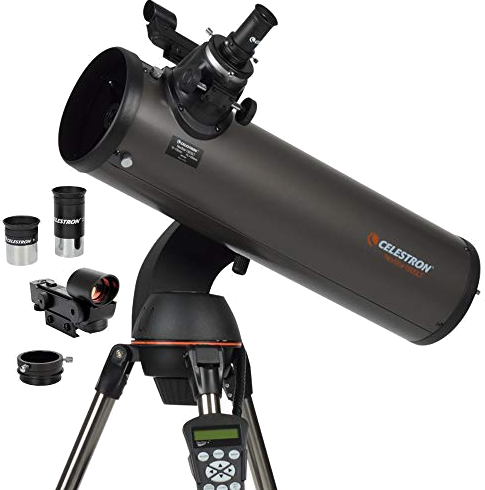
Celestron Computerized Telescope
- Newtonian Reflector Optical Design
- SkyAlign Technology with Computerized Hand Control
- 130mm (5.1-inch) Aperture
Celestron Nexstar SE telescopes
4 inch Make & Model: Celestron NexStar 4SE | 5 inch Make & Model: Celestron NexStar 5SE | 6 inch Make & Model: Celestron NexStar 6SE | 8 inch Make & Model: Celestron NexStar 8SE |
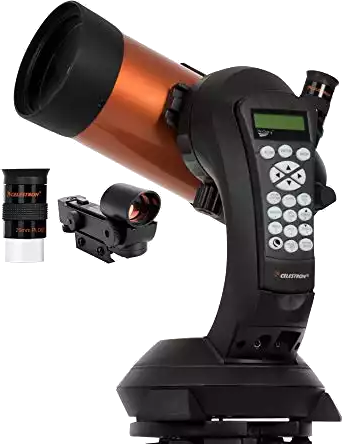 | 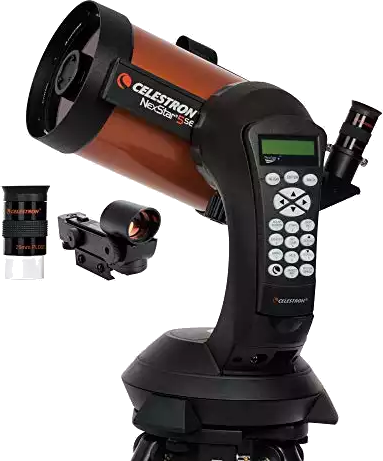 | 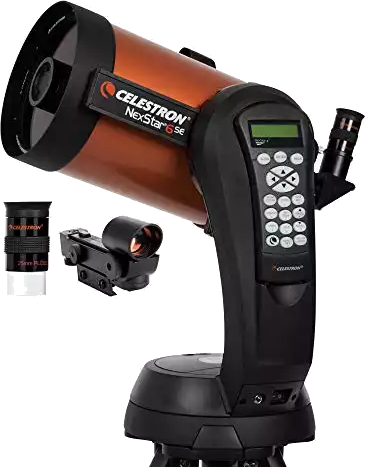 | 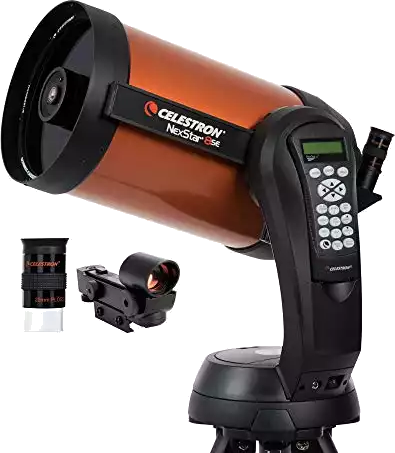 |
Telescope type: Maksutov-Cassegrain | Telescope type: Schmidt-Cassegrain | Telescope type: Schmidt-Cassegrain | Telescope type: Schmidt-Cassegrain |
Aperture: 4 inch | Aperture: 5 inch | Aperture: 6 inch | Aperture: 8 inch |
Focal length: 1325 mm (52 in) | Focal length: 1250 mm (49 in) | Focal length: 1500 mm (59 in) | Focal length: 2032 mm (80 in) |
Weight: 11 lbs (4.99 kg) | Weight: 17.6 lbs (7.98 kg) | Weight: 21 lbs (9.53 kg) | Weight: 33 lbs (15 kg) |
NexStar SE Telescopes
The NexStar SE range is designed with Celestron’s iconic orange tube, and this range of telescopes has possibly been the most popular computerized models in the past ten years.
The numbering in the name – 4, 5, 6, or 8 – refers to the size of the aperture of the telescope. So the 4SE has a 4-inch aperture, the 5SE 5-inches, etc.
The higher the number, the wider the aperture, the greater the light-gathering capabilities, and the greater the performance of the telescope to see objects in space.
Therefore, the 8SE is more powerful than the 6SE, the 6SE is more powerful than the 5SE, and so on. In effect, this means that with a more powerful telescope the objects are brighter and easier to see.
These are all catadioptric telescopes. The smallest (the 4SE) is a Maksutov-Cassegrain, with the larger three all Schmidt-Cassegrains.
These telescopes are good for beginners, but also more ambitious users and can work well for astrophotography. They tend to cost more than those in the SLT range, but less than the Evolutions below.
Some basics of the NexStar SE range are covered in this Celestron video:
Celestron NexStar 4SE
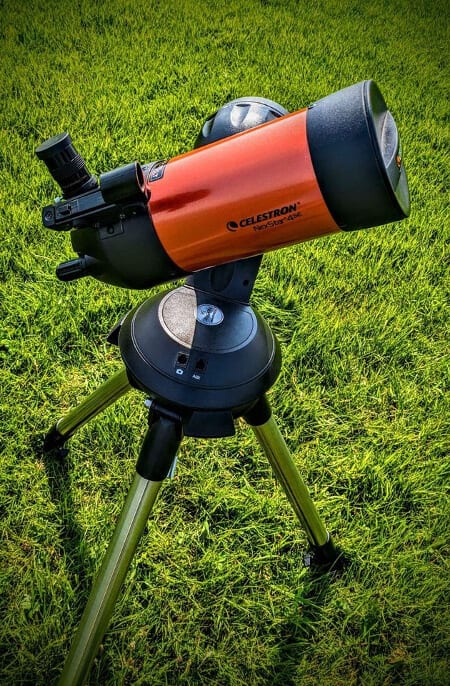
The Celestron NexStar 4SE is one of the most popular computerized telescopes for beginners.
It pretty much gives you everything you need for astronomy, is easy to use, relatively small and portable, and not too expensive.
Being the smallest of the range it is also the lightest and cheapest, but with the lowest aperture, it will be the most limited in what you will see through it.
Pros
- GOTO mount and tripod included can locate 40,000+ objects in space for you to view at the press of a button.
- Long focal length will deliver good views of the planets like Saturn, Jupiter and Mars, as well as great detail on the moon.
- Easy to set up and use.
- Battery-powered and portable – powered by 8 AA batteries or a portable PowerTank.
- Includes all accessories needed to get going right away.
Cons
- The lowest power (aperture) in the SE range.
- Not the best for astrophotography.
- Limited in viewing deep sky objects.
Key specifications
- Type: Catadioptric (Maksutov-Cassegrain)
- Aperture: 4 inches
- Focal Length: 1325 mm (52 inch)
- Focal Ratio: F/13
- Weight: 11 lbs (5 kg)
- Accessories: Star Pointer Finderscope, 25mm eyepiece
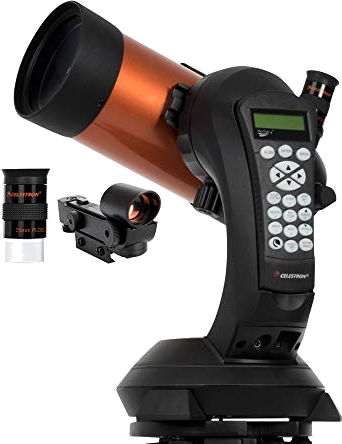
Great value computerized telescope
- The 4-inch primary mirror in this Maksutov-Cassegrain telescope packs enough light-gathering ability to observe the best that our Solar System has to offer, while retaining a compact form factor.
- Fully-automated GOTO mount featuring a database of more than 40,000 celestial objects that locates and tracks objects for you.
- Perfect for both beginners and advanced users
- The smallest in the NexStar SE range
- Requires a power source
- Heavier and more cumbersome than non-GOTO models
Celestron NexStar 5SE
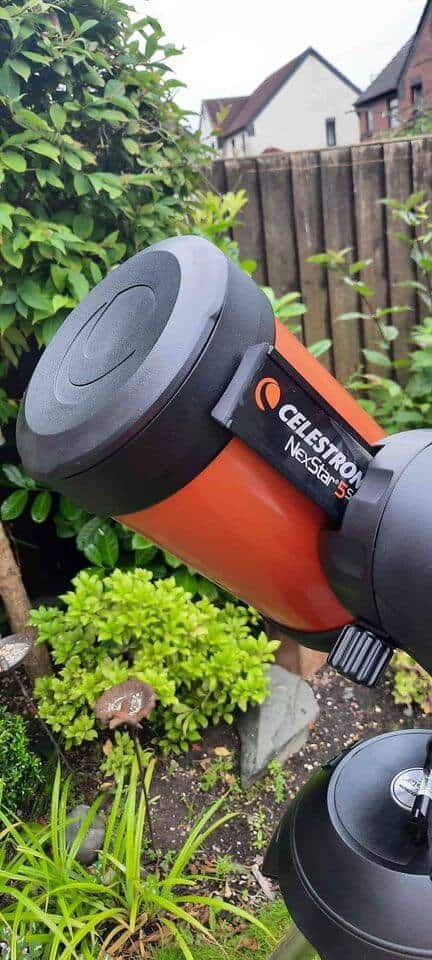
The Nexstar 5SE is a simple upgrade from the 4SE in that it has a larger 5-inch aperture instead of 4-inch. This means that it will deliver improved viewing of objects in space. This will be significant enough to see the difference.
The downsides are that it will cost more and it weighs a fair bit more too.
It is a Schmidt-Cassegrain compound model Everything else with the GOTO mount etc is exactly the same as the 4SE.
Pros
- Upgrade from the 4SE in terms of power and performance.
- Relatively light and portable.
- The computerized mount and tripod included can locate 40,000+ objects in space for you to view at the press of a button.
- The long focal length will deliver good views of the planets like Saturn, Jupiter and Mars, as well as great detail on the moon.
- Easy to set up and use.
- Battery-powered and portable – powered by 8 AA batteries or a portable PowerTank.
- Includes all accessories needed to get going right away.
Cons
- Heavier than the 4SE.
- More expensive than the 4SE.
- Not the best for astrophotography.
- Limited in viewing deep sky objects.
Key specifications
- Type: Catadioptric (Schmidt-Cassegrain)
- Aperture: 5 inches
- Focal Length: 1250 mm (49 inch)
- Focal Ratio: F/10
- Weight: 17.6 lbs (7.98 kg)
- Accessories: Star Pointer Finderscope, 25mm eyepiece, star diagonal
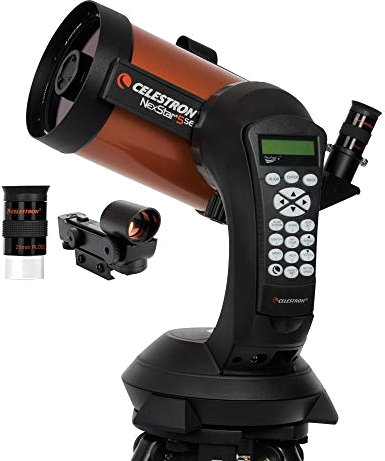
5-inch Aperture Schmidt-Cassegrain Telescope with GOTO Mount
- The 5-inch aperture in this Schmidt-Cassegrain telescope packs enough light-gathering ability to observe the best that the night sky has to see
- Fully-automated GOTO mount featuring a database of more than 40,000 celestial objects that locates and tracks objects for you.
- Compact size and easy to assemble and break down.
Celestron NexStar 6SE
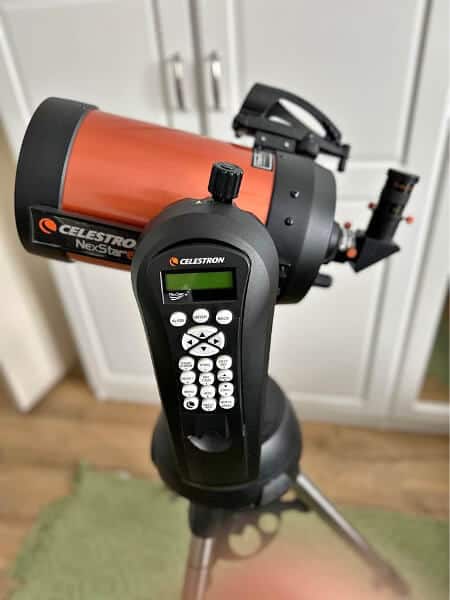
The step up from the 4SE or 5SE is the 6SE. The obvious key difference is the 6-inch aperture which will deliver significantly better views.
The other key difference is that this can be used for serious astrophotography with the addition of Celestron’s equatorial wedge.
This bit of gear turns the Alt-Az mount (which is great for astronomy) effectively into an equatorial mount (which is better for astrophotography).
Pros
- More powerful than the 4SE or 5SE.
- Still relatively light and portable.
- Can be optimized to excel for astrophotography with the addition of Celestron’s equatorial wedge.
- The computerized mount and tripod included can locate 40,000+ objects in space for you to view at the press of a button.
- Battery-powered and portable – powered by 8 AA batteries or a portable PowerTank.
- Includes all accessories needed to get going right away.
Cons
- More expensive than the lower aperture models.
- Heavier and bulkier.
Key specifications
- Type: Catadioptric (Schmidt-Cassegrain)
- Aperture: 6 inches
- Focal Length: 1500 mm (59 inch)
- Focal Ratio: F/10
- Weight: 21 lbs (9.53 kg)
- Accessories: Star Pointer Finderscope, 25mm eyepiece, star diagonal
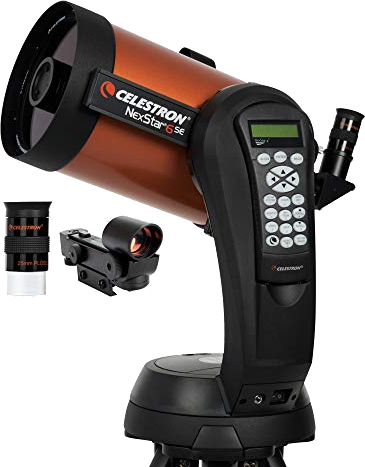
6-inch Aperture Schmidt-Cassegrain Telescope with GOTO Mount
- Large, 6-inch primary mirror packs enough light-gathering ability to deliver impressive views of the Moon and planets, along with deep-sky objects like the Orion Nebula, while retaining a compact form.
- A database of 40,000+ celestial objects, The GoTo mount locates and tracks objects for you. It's the perfect telescope for astronomy beginners.
- Assembling the telescope takes just a few minutes. When you're done observing, the telescope breaks down into small components for easy storage.
Celestron NexStar 8SE
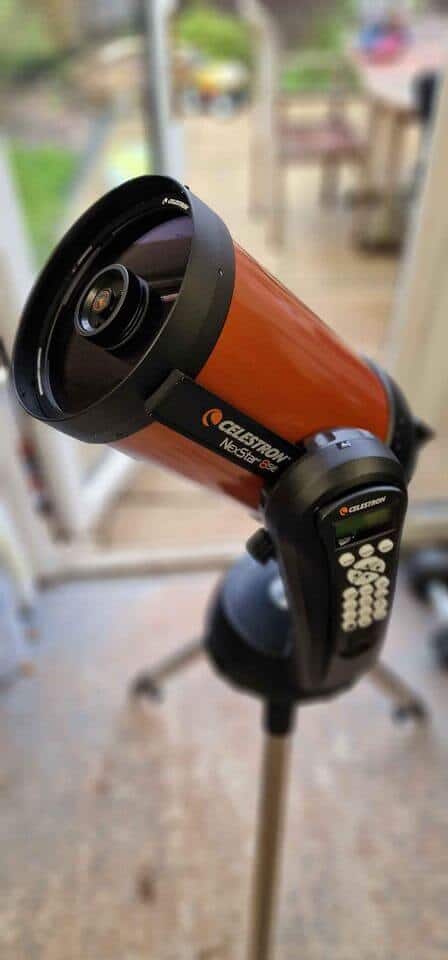
The biggest and best of the SE range is the NexStar 8SE.
With an 8-inch aperture, it is the largest and into the realms of the largest telescopes that you can get for home use (see here for the biggest telescopes you can buy).
Like the 6SE above, it can be converted into an astrophotography powerhouse with the addition of the wedge to optimize the included mount.
Pros
- Most powerful, providing the best images of deep sky objects.
- Can be optimized to excel for astrophotography with the addition of Celestron’s equatorial wedge.
- The computerized mount and tripod included can locate 40,000+ objects in space for you to view at the press of a button.
- Battery-powered and portable – powered by 8 AA batteries or a portable PowerTank.
- Includes all accessories needed to get going right away.
Cons
- Most expensive.
- Heaviest and least portable.
Key specifications
- Type: Catadioptric (Schmidt-Cassegrain)
- Aperture: 8 inches
- Focal Length: 2032 mm (80 inch)
- Focal Ratio: F/10
- Weight: 33 lbs (15 kg)
- Accessories: Star Pointer Finderscope, 25mm eyepiece, star diagonal
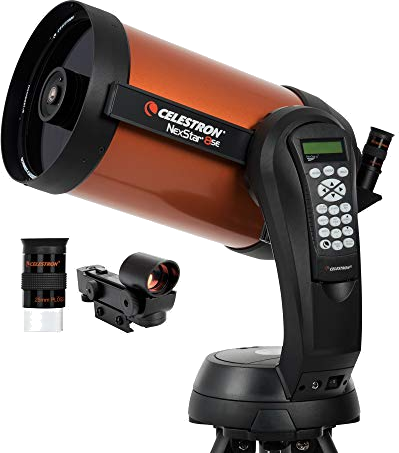
Celestron's most popular advanced GOTO telescope package
- Powerful 8-inch aperture
- Easy-to-use computerized mount finds objects for you to view at the press of a button
- All you need in one package, with telescope, mount, and tripod
- Price is kept down by the inclusion of the less-sturdy mount
- No built-in WIFI
Which NexStar SE is right for you?
It will depend on your priorities and budget as to which NexStar SE model is right for you.
As each model increases in aperture, the better the views it will deliver, but also the more it will cost (although check live prices when buying as you never know if you might find a good deal).
A downside of the increased aperture is the increased weight. Making the better views at the cost of portability.
A key aspect to consider is whether you will want to be doing photography with your NexStar SE Telescope.
If so, then the upgrade of the equatorial wedge to the 6SE and 8SE can significantly improve the astrophotography performance.
In summary then:
Celestron NexStar Evolution telescopes
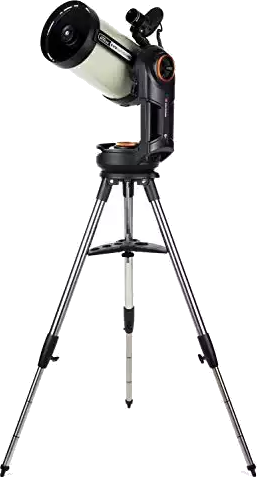
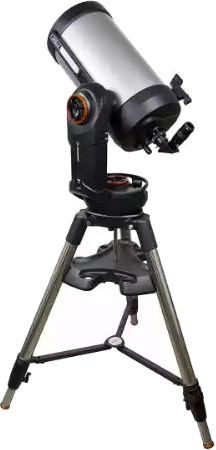
6 inch Make & Model: Celestron NexStar Evolution 6 | 8 inch Make & Model: Celestron NexStar Evolution 8 | Astrophotography Make & Model: Celestron NexStar Evolution 8 EdgeHD | 9.25 inch Make & Model: Celestron NexStar Evolution 9.25 |
 |  |  |  |
Telescope type: Schmidt-Cassegrain | Telescope type: Schmidt-Cassegrain | Telescope type: Schmidt-Cassegrain | Telescope type: Schmidt-Cassegrain |
Aperture: 150 mm (6 inches) | Aperture: 203 mm (8 inches) | Aperture: 203 mm (8 inches) | Aperture: 235 mm (9.25 inches) |
Focal length: 1500 mm (59 inches) | Focal length: 2032 mm (80 inches) | Focal length: 2032 mm (80 inches) | Focal length: 2350 mm (93 inches) |
Weight: 38 lbs (17 kg) | Weight: 40.5 lbs (18 kg) | Weight: 42 lbs (19 kg) | Weight: 62.6 lbs (28.4 kg) |
The Premium NexStar Telescopes
The Celestron NexStar Evolution range is the most advanced of the three different NexStar series.
These are all Schmidt-Cassegrain telescopes (a specific type of compound/catadioptric telescope) with GoTo/Computerized capabilities.
Like the NexStar SE range, the numbers indicate the aperture of the telescope tube in inches. I.e. the Evolution 8 has an 8-inch aperture.
The one notable difference is the Evolution 8 EdgeHD which is optimized for astrophotography by the improved optics correcting for coma – a type of distortion that appears at the edge of images with SCTs.
A quick overview of the Evolution telescopes can be seen in this video:
Now let’s compare the four Evolution models.
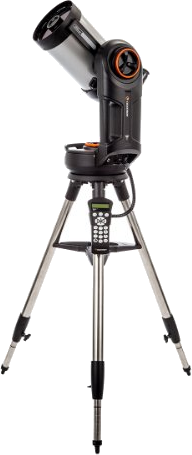
Celestron NexStar Evolution 6
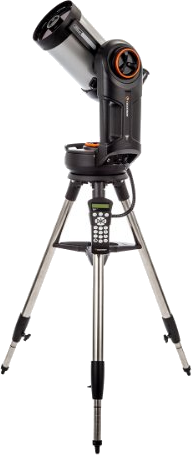
The Celestron NexStar Evolution 6 has a 6-inch aperture and is the smallest (and cheapest) in the premium range of Evolution telescopes.
It is an upgrade from the 6SE which has the same aperture but the Evolution’s included computerized mount excels for astrophotography.
It is also rechargeable via USB, therefore no AA batteries are needed.
Pros
- Powerful with high aperture.
- Good for astrophotography.
- Built-in battery rechargeable via USB.
Cons
- Usually more expensive than the 6SE or 8SE models.
- Heavy, even though it’s the lightest in the Evolution range.
Key specifications
- Type: Catadioptric (Schmidt-Cassegrain)
- Aperture: 6 inches (150 mm)
- Focal Length: 1500 mm (59 inches)
- Focal Ratio: F/10
- Weight: 38 lbs (17 kg)
- Accessories: Red dot finderscope, star diagonal, 40mm and 13mm eyepieces
6-inch Aperture GOTO Telescope Package
- Compact, portable Schmidt Cassegrain telescope with StarBright XLT optical coatings and Fastar compatibility
- Computerized mount with high-performance worm gears and motors for improved tracking accuracy and reduced gear backlash
- Control wirelessly from your smartphone or tablet with mobile app
- Rechargeable lithium-ion battery with 10 hours power
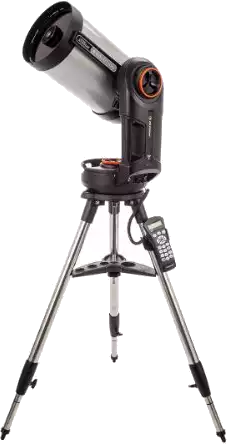
Celestron NexStar Evolution 8
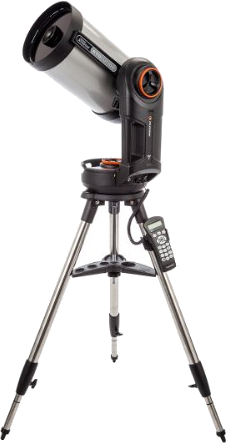
The next step up from this is the Evolution 8.
As the name suggests, it has an 8-inch aperture which is pretty large and powerful.
In comparison to the Nexstar 8SE, it has a better mount that will work better for astrophotography and its power unit is internal and rechargeable via USB.
Pros
- Powerful with high aperture.
- Good for astrophotography.
- Built-in battery rechargeable via USB.
Cons
- Usually more expensive than the 8SE.
- Heavy.
Key specifications
- Type: Catadioptric (Schmidt-Cassegrain)
- Aperture: 8 inches (203 mm)
- Focal Length: 2032 mm (80 inch)
- Focal Ratio: F/10
- Weight: 40.5 lbs (18 kg)
- Accessories: Red dot finderscope, star diagonal, 40mm and 13mm eyepieces
Celestron's Premium 8-inch SCT package
- Powerful 8-inch telescope provides high-quality views
- In-built wifi and battery power source make it a true all-in-one package
- Tall tripod and sturdy mount
- Relatively heavy
- Can be used for astrophotography but not specialized for this
Celestron NexStar Evolution 8 EdgeHD
The Evolution 8 EdgeHD is identical to the Evolution 8 above but has EdgeHD optics.
These EdgeHD optics correct for field curvature and coma that are inherent in SCT telescopes, this means that the EdgeHD version of the 8 is better specifically for astrophotography.
In addition, it features Celestron’s Fastar technology which effectively speeds up the focal ratio from f/10 to f/2. It does this by allowing you to remove the secondary mirror so you can place your camera on the front of the optical tube.
Pros
- Brilliant for astrophotography but also can be used for astronomy viewing.
Cons
- Heavy.
- Usually more expensive than the Evolution 8.
Key specifications
- Type: Catadioptric (Schmidt-Cassegrain)
- Aperture: 8 inches (203 mm)
- Focal Length: 2032 mm (80 inch)
- Focal Ratio: F/10, but convertible to F/2 with FaStar
- Weight: 42 lbs (19 kg)
- Accessories: Red dot finderscope, star diagonal, 40mm and 13mm eyepieces
Premium 8-inch Astrophotography Telescope Package
- Powerful 8-inch telescope
- EdgeHD optics optimized for astrophotography use
- In-built wifi and battery power source make it a true all-in-one package
- Tall tripod and sturdy mount
- Expensive
- Need to add an Equatorial Wedge to upgrade the mount
Celestron NexStar Evolution 9.25
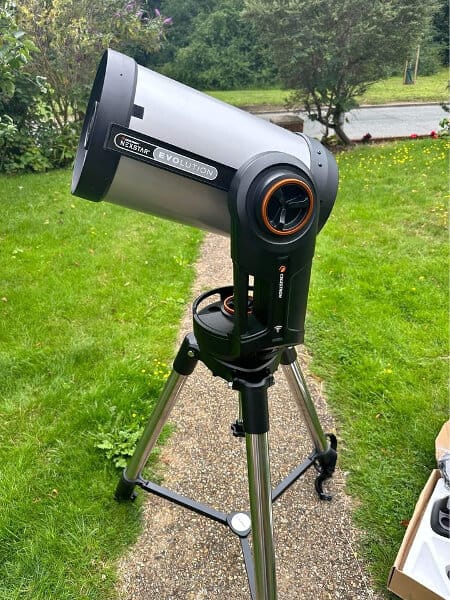
The biggest and best of the Evolution range is the NexStar Evolution 9.25.
With a 9.25-inch aperture, it is the largest of any of the NexStar telescopes. It features all the positives of the Evolution 6 and Evolution 8 models.
Pros
- Largest aperture for the best viewing.
Cons
- Expensive.
- Less optimized for astrophotography than the Evolution 8 EdgeHD.
Key specifications
- Type: Catadioptric (Schmidt-Cassegrain)
- Aperture: 9.25 inches (235 mm)
- Focal Length: 2350 mm (93 inches)
- Focal Ratio: F/10
- Weight: 62.6 lbs (28.4 kg)
- Accessories: Red dot finderscope, star diagonal, 40mm and 13mm eyepieces
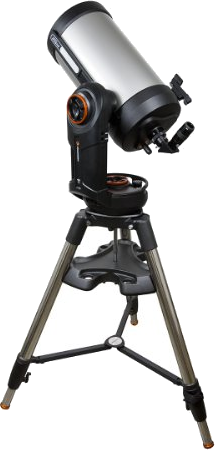
9.25-inch Aperture GOTO Premium Telescope Package
- Compact, portable Schmidt Cassegrain telescope with StarBright XLT optical coatings and Fastar compatibility
- Large 9.25-inch Aperture for great light gathering capacity
- Control wirelessly from your smartphone or tablet
- Premium computerized mount with high-performance worm gears and motors for improved tracking accuracy
Which NexStar Evolution is right for you?
The choice between the Evolution 6, 8, and 9.25 is pretty straightforward – how much do you value the extra aperture for the higher cost (and extra weight)?
If you want the best option for deep sky astrophotography (and have the budget) then the Evolution 8 EdgeHD will be best for you.
If you want to read more then see our in-depth comparison of the Evolution 8 vs 8 HD vs 8SE.
Comparing NexStar models
Let’s now further examine the key comparable characteristics between these 11 NexStar telescope models.
Celestron NexStar Aperture Comparison
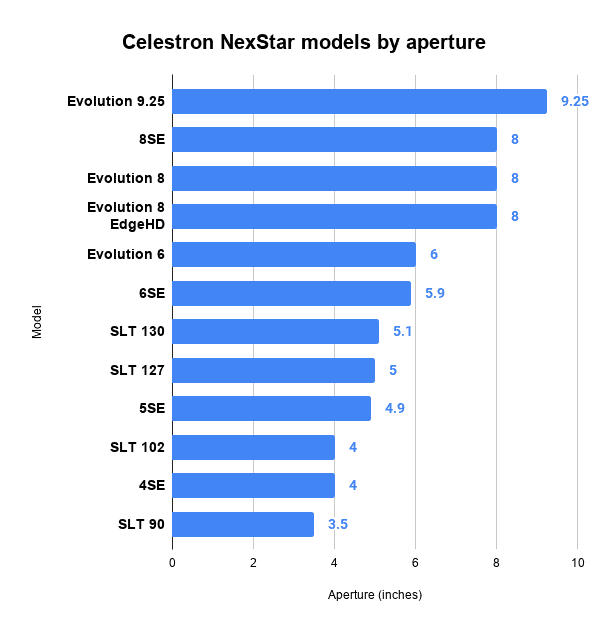
Starting with aperture – the best measure of a telescope’s light-gathering capabilities.
As you can see in the chart below, although the Evolutions are the premier range, followed by the SE’s and then the SLT’s, it is not a straightforward progression in terms of aperture.
For instance:
- the 8SE is only below the Evolution 9.25
- the SLT 130 and 127 compare closely with the 5SE, and
- the 4SE and SLT 102 are very close by this measurement
Celestron NexStar Telescope Types
The NexStars are mostly Maksutov-Cassegrain (“Maks”) or Schmidt-Cassegrain (“SCT”) telescopes, as you can see in the table below.
These are versions of compound (or catadioptric) telescopes. These are generally great as they are small, compact, and portable, whilst offering high aperture and good viewing capabilities.
The downside is that they generally cost more than reflectors or refractor telescopes at similar apertures.
Only the SLT 102 (refractor) and SLT 130 (reflector) are not compound/catadioptric telescopes.
The SLT 130 reflector is therefore much bulkier than the SLT127 or the 5SE to which it compares.
| NexStar Model | Type |
|---|---|
| SLT 90 | Maksutov-Cassegrain |
| SLT 102 | Refractor |
| SLT 127 | Maksutov-Cassegrain |
| SLT 130 | Newtonian Reflector |
| 4SE | Maksutov-Cassegrain |
| 5SE | Schmidt-Cassegrain |
| 6SE | Schmidt-Cassegrain |
| 8SE | Schmidt-Cassegrain |
| Evolution 6 | Schmidt-Cassegrain |
| Evolution 8 | Schmidt-Cassegrain |
| Evolution 8 EdgeHD | Schmidt-Cassegrain |
| Evolution 9.25 | Schmidt-Cassegrain |
The differences between Maksutov-Cassegrain and Schmidt-Cassegrain telescopes are fairly minimal but SCTs are generally better performing.
Essentially, Maksutov-Cassegrains have thicker corrector lenses than Schmidt-Cassegrains. This means that they take longer to adjust to temperature changes (for example, when being taken from inside to outside).
This is a factor for viewing and taking images as if the telescope has not adjusted it will result in distortion.
This is especially important for large apertures and is why the Maks are the smaller models, and then the larger telescopes are all SCTs.
For more detail on this, see our article Maksutov-Cassegrain vs Schmidt-Cassegrain (Which is Best for You?).
Which Celestron NexStar is best for astrophotography?
All of the NexStar telescopes can be used for astrophotography. In general though:
- The SLTs will work best using either smartphones (attached with an adapter) or with small, dedicated astronomy cameras. This is because the mounts they come with are limited in the weight they can take, and so attaching a bigger camera will be difficult. Also, the lower aperture and focal ratios will limit what you could photograph beyond the moon or perhaps some planets.
- The NexStar SE can work well for astrophotography using smartphones, dedicated astronomy cameras, and DSLR/mirrorless cameras attached with adapters. There is a wedge that can be added to the 6SE and 8SE which effectively turns the mount from an Alt-Az (best for astronomy) to an equatorial (best for astrophotography).
- The NexStar Evolution models are great for astrophotography and you can also add Celestron’s equatorial wedge to allow longer exposures of deep sky objects. The Evolution 8 EdgeHD version is specifically optimized for astronomy imaging with improved optics.
In short: SLTs ok, SEs good, Evolutions excellent.
In terms of specific models, the best are the NexStar 6SE and 8SE with the wedge added, or any of the Evolution models, but specifically the 8 EdgeHD.
Celestron NexStar Accessories
Further to this, something that you might not think about is the accessories that you might want to add on:
- If you think you will want to transport it around then you will need a case – like this one from Celestron
- If you have the 6SE or 8SE or any of the Evolution models you can buy the equatorial wedge to improve the astrophotography performance
- You might want to add an eyepiece and filter set
- If you are interested in using your DSLR or mirrorless camera with your telescope to take photos of what you can see then you will need a T-adapter and T-ring. (The links provided here are for DSLR cameras and so be sure to find the right parts tailored for your camera.)
- Anti-vibration pads can help reduce any shake that might come from being near a road or similar. This would be especially important for long exposure deep sky photography.
- Also, for the SLT and SE models, rather than constantly running on batteries you may also want to get an electricity adapter or a portable PowerTank.
Conclusion: Which Celestron NexStar is right for me?
In summary:
- The SLTs are great budget, beginner computerized telescopes that are mostly small and compact.
- The SEs are more serious telescopes and the bigger the better in terms of power, with the 6SE and 8SE also potentially being great for astrophotography. The 4SE is very popular with people wanting a step above the SLTs but for the lowest price.
- The Evolutions are the best overall but are also priced accordingly. The Evolution 9.25 is the best of the bunch for astronomy and the 8 EdgeHD the best for astrophotography.
For further details on these telescopes, you can also check out Celestron’s website.
You can find more guides like this in our Astronomy hub, and to find the most high-powered models, see our guide to the Most Powerful Home Telescopes.