Monoculars can also be great for astronomy (and even astrophotography).
They are ultra-compact, light, and easy to use, so have many advantages over telescopes and binoculars, particularly when traveling.
Here we recommend the best monocular for stargazing for different budgets and explain what to look for when buying.
Our top picks are:
— Best Overall and Most Powerful: Celestron Outland X 20×50 Monocular
— Best Wide Field of View: Celestron Outland X 10×50 Monocular
— Best Budget: Barska Blackhawk 10×25 Waterproof Monocular
— Best Night Vision: Sionyx Aurora Black
Best Monocular for Stargazing
Celestron Outland X 20×50 Monocular
Best Overall and Most Powerful Monocular for Stargazing
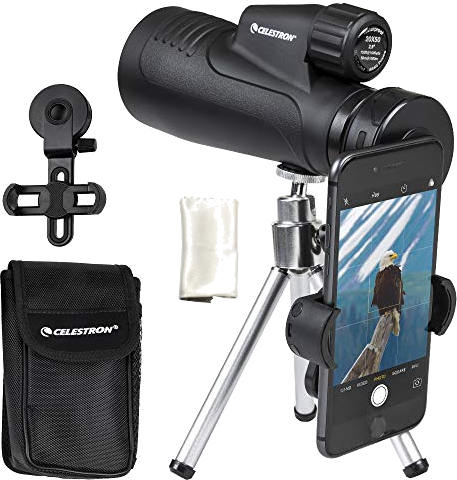
The Celestron Outland 20×50 Monocular gives you high magnification and includes a tripod to give you all you need for viewing and photographing the moon.
Whereas the 10×50 model below will give you a wider view of the sky and may be better for scanning for shooting stars or meteor showers, this model enables you to get closer in on astronomical objects like the moon.
The tripod bypasses the issue of unsteadiness of high magnification when using by hand and means that these are perfect for smartphone photography.
These are high-quality monoculars that will work brilliantly for observing and photographing the moon. If planets like Mars are visible you may also be able to capture them in images (although don’t expect too much).
Pros
- Celestron is one of the most reliable brands of astronomy gear
- 20 times magnification for close-up views of the moon
- 50mm lenses can provide bright clear views
- Tripod and smartphone photography adapters enable it for astrophotography and capturing images of the moon
- Quality Bak-4 prisms and multi-coated optics for clear contrast and views
- Includes bag for easy travel and storage
Cons
- Eye relief is lower than with the 10×50 model and so less suitable for glasses wearers
- More expensive than budget options
- Higher magnification is less suitable for scanning wider expanses of the sky for meteor showers etc
Key specifications
- Lens Diameter: 50mm
- Magnification: 20x
- Weight: 1.15lb
- Eye relief: 11mm
- Accessories: Tripod, carry case, smartphone photography adapter.
High-quality monocular including tripod and smartphone adapter
- Large 50mm objective lens with excellent light-gathering capability
- 20x magnification for close-in shots of far off objects
- BaK-4 prisms and multi-coated optics provide improved contrast and resolution
- Smartphone adapter, tripod, and Bluetooth remote included
- Low Eye Relief and so less suitable for glasses wearers
- Higher magnification less suitable for scanning the sky
Celestron Outland X 10x50mm Monocular
Best Wide Field of View Monocular for Stargazing
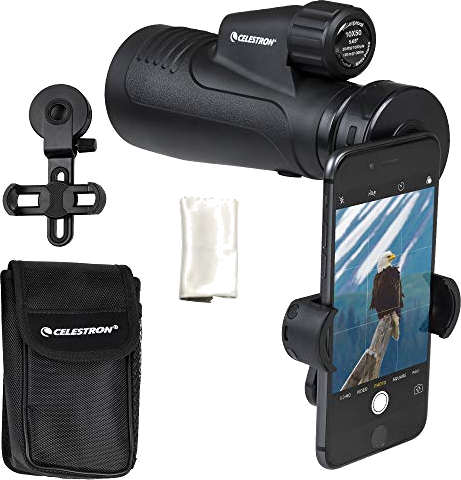
The Celestron Outland 10×50 Monocular is a light, compact, but powerful bit of gear that you can use to observe the night sky.
It is cheaper and has a wider field of view compared to the 20×50 model above.
The 10×50 in the name refers to:
- 10 times magnification – this is good for being able to scan the sky with a suitably wide field of view. Higher magnification means you zoom in more but also it narrows the expanse of the sky you can see, so you don’t want this too high with stargazing (unless you only want to observe the moon – see more on this below).
- 50mm lens diameter – this is a good width of lens to enable clear views. To put it in context, you can get good budget telescopes and binoculars with 60-70mm lenses.
This model comes with a carry bag for easy packing and storage, as well as a smartphone adapter so that you can use it to take pictures or videos.
Pros
- Celestron is one of the most reliable brands for astronomy gear
- 10 times magnification for a wide of field of view
- 50mm lenses can provide bright clear views
- Quality Bak-4 prisms and multi-coated optics for clear contrast and views
- Eye relief (the distance you need to have your eye from the eyepiece) is good to be suitable for people wearing glasses
- Includes bag for easy travel and storage
- Can be used for photography with a smartphone and includes an adapter
Cons
- You may prefer higher magnification for closer views of the moon
Key specifications
- Lens diameter: 50mm
- Magnification: 10x
- Weight: 1.15lb
- Eye relief: 16.8mm
- Accessories: Carry case, smartphone adapter
High-quality monocular including smartphone adapter
- Large 50mm objective lens with excellent light-gathering capability
- 10x magnification for wide field of view stargazing
- BaK-4 prisms and multi-coated optics provide improved contrast and resolution
- Smartphone adapter and Bluetooth remote included
- You may prefer higher magnification for closer views of the moon
Barska Blackhawk 10×25 Waterproof Monocular
Best Budget Monocular for Stargazing
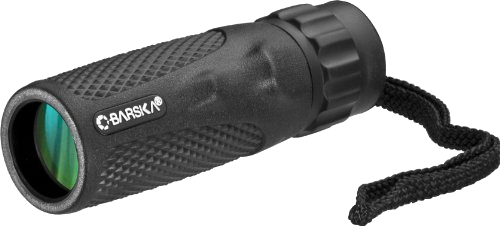
The Barksa 10×25 is a small, lightweight monocular for stargazing. The 10x magnification means you get a wide field of view for scanning the night sky.
Like Celestron, Barksa is a reliable brand for optical equipment.
Weighing just 0.15 pounds and measuring 4.25 inches long, this monocular is your perfect travel companion. Whether you’re hiking, camping, or simply enjoying a night on your porch, its compact size ensures that it fits effortlessly into your backpack or pocket.
The waterproof rubber-armored construction of the monocular ensures that you can take it on trips without worry. While it’s not designed for submersion or scuba diving, it can handle rain and damp conditions.
The close focus of 20 inches lets you view even up-close objects with clarity. This versatility adds to the overall appeal of the monocular, making it suitable for various outdoor activities.
For extended stargazing sessions, the monocular features a small tripod adapter socket, allowing attachment to any field or photographic tripod. This adds stability and comfort to your observations, enhancing the overall experience.
This is a great stargazing monocular option if you want something super small that you can slip in your pocket and take out with you on trips.
Pros
- Ultra small and lightweight – perfect for camping and travel
- Barksa are a reliable manufacturer of quality gear
- 10x magnification gives you a wide field of view of the night sky
- Waterproofing means you don’t have to worry about the conditions
- Can attach to a regular tripod for photography without the need for an adapter
Cons
- 25mm lens diameter is smaller than other options and will not have as good views
- No tripod or smartphone adapter included
Key specifications
- Lens Diameter: 25 mm
- Magnification: 10x
- Weight: 0.15 lbs
- Eye relief: 17mm
- Accessories: Carry case
Budget Handheld Monocular
- Ultra small and lightweight - perfect for camping and travel
- Waterproofing means you don't have to worry about the conditions
- No tripod or smartphone adapter included
- Less powerful than other stargazing monoculars
Sionyx Aurora Black
Best Night Vision Monocular for Stargazing
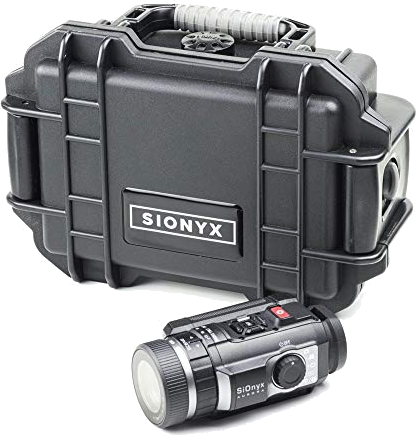
The Sionyx Aurora Black is a more advanced option than the models above as it is a night vision camera that can be used as a monocular.
The in-built infrared camera inside lights up the night sky when you look at it through the device, enabling you to have a different level of dark sky viewing than you would through a regular monocular.
The primary purpose for these has mostly been hunting, but astronomers have been taking advantage of them for stargazing in recent years and make a great option for dark sky viewing.
It can also be attached to a telescope for advanced astronomy and astrophotography and you can live stream the images to your tablet or smartphone by using the app that comes with it.
In fact, night vision astronomy is a fast-growing hobby. Here’s a very short video clip that you can see here of the Sionyx Aurora being used for stargazing to give you a feel of what you might be able to expect:
Here also are some images displaying starry night sky pictures captures with a Sionyx Aurora:


See also this album here of images taken with the Aurora.
These are great night vision monoculars for stargazing and a good alternative to regular monoculars if you have the budget.
Pros
- Night vision monocular to light up the sky as you view it
- In-built camera can be used for astrophotography and can be connected to telescopes
- Live stream the image feed on to your smartphone with the app
- It is compact, light and portable
Cons
- Quite a bit more expensive than a regular monocular
- Requires batteries as a power source
Key specifications
- Weight: 0.6lb
- Accessories: Hardshell case, batteries
Color Digital Night Vision Monocular
- Night vision monocular to light up the sky
- In-built camera can be used for astrophotography and can be connected to telescopes
- Live stream the image feed on to your smartphone
- Compact, light and portable
- More expensive than a regular monocular
- Requires batteries as a power source
Sionyx Aurora vs Pro vs Black
There are three different monoculars in the Sionyx Aurora range: the Black which we have covered above, plus the Original Aurora, and the Pro. The key differences are:
- SiOnyx Aurora: The same as the Aurora Black above but with a built-in compass and GPS.
- SiOnyx Aurora Pro: The Pro is the premium model and has the most sensitive camera, however it is the most expensive.

Best Handheld Telescope for Stargazing: Buying Guide
A monocular is essentially a small refractor telescope or half a set of binoculars, however you want to think about it.
The purpose is to give you a similar degree of optical power but in a small device that can be held in one hand.
The key specifications are the ‘number x number’ that is usually in the name. For example, 10×50 or 8×42. This refers to the magnification and the lens diameter:
- The first number is the magnification, i.e. 10x will bring what you are seeing 10 times closer. As explained below, higher is not always better for stargazing.
- The second number is the objective lens diameter in millimeters, i.e. 50mm. The higher this number, the brighter and clearer views you can expect to see.
Magnification
The first point to consider with buying monoculars for stargazing is that higher magnification is not necessarily better.
Higher magnification means you zoom in more but this means two potential negatives:
- Firstly, it narrows the field of view so that you are seeing a smaller expanse of the sky through the eyepiece/viewfinder. If you are planning on scanning the skies to spot meteor showers or satellites etc, then this won’t be what you want.
- Secondly, it also means that your view will be more unsteady when using by hand as this becomes more exaggerated the higher the magnification is.
Higher magnification with monoculars for astronomy can be better though if you really want to zoom in on the moon, or maybe some of the visible planets of the solar system.
Since the moon is a relatively close night sky object, high magnification means you will be better able to view (and photograph) its features.
Objective Lens Diameter
What you do want that is higher is the lens diameter as that is the best indicator of how bright and clear the viewing through it will be.
The monoculars recommended in this article range from 42mm to 50mm. This is good for relatively inexpensive gear for stargazing and to compare you can get good telescopes or astronomy binoculars with 60-70mm lenses (aperture).
Other Factors to Consider
You will see other specifications listed on sale pages of monoculars that it is worth knowing about:
- Lens Coating: Multi-coated lenses and BaK-4 prisms maximize the light transmission for brighter and more detailed images.
- Durability: Better manufacturers (like those listed on this page) will be more likely to provide durable gear. There are some very cheap monoculars on Amazon that might be fun for a short while, but will provide poor optics and be short-lived if used regularly.
- Eye Relief: This is how far away your eye needs to be from the eyepiece when looking through it. This is particularly important for glasses wearers as if you wear glasses you will want higher eye relief or else your glasses will get in the way.
- Accessories: The most common is a bag or carry case. Smartphone adapter and tripod is a great bonus for using for photography or astrophotography.
FAQs: Monoculars for Stargazing
Are binoculars or monoculars better for stargazing?
A monocular is essentially half a binocular, so they are pretty similar. However, there are a number of dedicated astronomy binoculars on the market with much bigger lenses and so perform better.
The downside of larger astronomy binoculars is that they need to be used with a tripod to get the best out of them, whereas a monocular is designed to be handheld and so can be great for casual use and travel.
Are spotting scopes or monoculars better for stargazing?
Spotting scopes generally have higher magnification and larger lenses. The larger lenses will give you clearer views but, as discussed above, the higher magnification is not necessarily best for stargazing as it results in a narrower field of view and you are looking at a smaller expanse of the sky.
Low magnification but large lens diameter monoculars should then generally be better than spotting scopes for stargazing.
Read more on this in our article on Spotting Scopes for Astronomy.
Can you use a night vision monocular for astronomy?
Yes, night vision astronomy and astrophotography is a growing trend.
We recommend the Sionyx Aurora Black as a good night vision monocular for stargazing.
Can you use a monocular for astrophotography?
Yes, with a tripod and smartphone adapter you can use monoculars for astrophotography. We recommend the Celestron Outland 20×50 Monocular as the best option for this.
Realistically, your best shots will be of the moon and not galaxies of other deep space objects.
What is the most powerful monocular?
The Celestron Outland 20×50 is the most powerful stargazing monocular that we recommend.
Power is best gauged by the magnification (20x) and the lens diameter (50mm).

Verdict – Best Monoculars for Stargazing
In summary, we recommend:
- Best Overall – Celestron Outland X 20×50 Monocular – The most powerful monocular for stargazing and comes with tripod and smartphone adapter for photography
- Best Widefield – Celestron Outland X 10×50 Monocular – A cheaper alternative to the above with lower magnification which can actually be better for scanning the night sky
- Best Budget – Barska Blackhawk 10×25 Waterproof Monocular – Cheap and great for travel with the smaller size and low weight
- Best Night Vision – Sionyx Aurora Black – A great option if you want to explore night vision stargazing
We hope you found this guide useful to you in researching the best monoculars for stargazing and handheld telescopes for astronomy.
If you have any questions, please let us know in the comments below.
Sources:
- https://www.celestron.com/collections/monoculars
- https://www.cloudynights.com/topic/856098-best-astronomy-monocular/
- https://www.sionyx.com/
- https://www.cloudynights.com/gallery/album/10410-sionyx-aurora/?st=48
- https://www.reddit.com/r/Astronomy/comments/2rdu8t/binocular_or_monocular/
Related articles: